Showing posts with label Works of Jean Shepherd. Show all posts

Friday, December 13, 2024

A Christmas Story Christmas (2022)

My review of "A Christmas Story Christmas" originally published in the "Junction City Union" back in 2022. I reposted it here because it's not available online anymore. I made a few slight corrections from the original review, and added some imagery. Cheers! 

'A Christmas Story' sequel captures writer Jean Shepherd's irony and humor
Mike Sellman 
3.5 out of 4 stars

I believe I'm among a large audience who hasn't let a Christmas season go by without watching the 1983 holiday comedy, "A Christmas Story" at least once. I've been doing it for approximately the last 35 years. It seems like a movie people either love or dislike, the latter slandering the film with comments about it being "too silly" or "largely overrated." Regardless, I still make it a point to watch it every holiday season.
Never did I think I would see the actors from "A Christmas Story" return to their roles for a follow-up film. 
But they did in the sequel, "A Christmas Story Christmas," released Nov. 17, 2022 on HBO Max. 
The original movie, "A Christmas Story," directed by Bob Clark and released in 1983, is based on the books, "In God We Trust: All Others Pay Cash" and "Wanda Hickey's Night of Golden Memories and Other Disasters" by humor writer Jean Shepherd who passed away in 1999. It's also narrated by Shepherd who makes a cameo. Look for him. He's in there. 
Set in fictional Hohman, Ind. in the 1940s, the comedy holiday movie tells the story of young Ralphie Parker (played by Peter Billingsly) and his quest for a Red Ryder BB gun for Christmas. 
Billingsly is back playing Ralphie after nearly 40 years in this sequel. 
This continuing story takes place in 1973 - 33 years after young Ralphie got his BB gun.
Ralphie, now a struggling writer, lives in Chicago with his wife, Sandy (Erinn Hayes), their son Mark (River Drosche) and youngest child, Julie (Julianna Layne). 
He has taken a year off to write his first novel. He's been trying to have his manuscript published, only to be turned down by publisher after publisher. 
In the midst of this struggle, and as Christmas approaches, Ralphie gets a call from his mother (Julie Hagerty) with some tragic news. His father, (played in the original film by Darren McGavin) has died. 
Grieving, Ralphie's family heads to his childhood home in Hohman to be with his mother. 
When they arrive, Mrs. Parker asks Ralphie to write his father's obituary. On top of that, despite the tragic loss of his "old man," she wants him to take up the task of making Christmas wonderful for the family in memory of his dad who had a great affinity for the holiday season.
Of course, in the midst of Ralphie reacquainting with his old friends at the local bar owned by his childhood buddy Flick, played again by Scott Schwartz, and getting ready to celebrate Christmas, small yet unthinkable disasters descend upon him and his plans. 
Jean Shepherd is one of the best satirical story tellers in American story telling history. His stories amazingly depict the fondly remembered yesteryear of Americana with all its imperfections and disappointments, all with charming relatability.  
Peter Billingsly as 'Ralph Parker' in "A Christmas Story Christmas."
Whether reading his words, or listening to his old radio programs, the nostalgic Americana flows naturally from his mind. He's the Norman Rockwell of the written word. 
Shepherd's work doesn't mock. He just sees through the glisten of America's bygone "golden" era. 
No matter how wonderful, warm and memorable the American yesteryear is, Shepherd doesn't fail to point out the vexations, great and small, that came with day-to-day life of the 1940s on. This wit comes through enjoyable well and clear in "A Christmas Story Christmas." 
It's an element that makes the original movie well loved. 
While the movie is certainly a tribute to actor Darren McGavin, it also pays a great amount of tribute to Shepherd. That doesn't surprise me as his children, Randall and Adrian Shepherd, are co-producers of "A Christmas Story Christmas."
In the movie, Ralphie sets up his writing space up in the attic of his boyhood home on Cleveland Street. 
He finds his old typewriter and sets it up. The scenario works as a means to call back old memories seen in the first movie.
Of course, now those "memories" are covered in dust and cobwebs. Thankfully, these call-backs aren't overplayed with gushy nostalgic sentimentalities. 
Rather, the first movie is called back to memory here and there, from time to time, through props, jokes, or similar shots as seen in the part one. 
Yet, it doesn't completely depend on part one to tell a new and just-as-relatable story. 
Though the first movie doesn't end on any kind of cliffhanger. the new movie manages to say something meaningful. 
Some of the jokes and references are updated. Ralphie's daydreams for instance, as seen in part one, is a habit continues into his adult years.
One such fantasy Ralphie has is of himself winning the Pulitzer Prize. He has this fantasy while in the office of a publisher who's rejecting his work. 
What writer hasn't fantasized about their work winning a Pulitzer amidst a standing ovation?
A few scenes were recreated from the first film, such as the escalator ride up to see Santa Claus in Higbee's Department Store.
Other scenes are updated, such as Ralphie bribing a potential publisher with Christmas candy. a habit he practiced when trying to score a good grade on his writing assignment from his schoolteacher, Miss. Shields, in the first film. 
Such callbacks are mere fan service rather than depending on the humor and scenes from part one. Other parts in the film feel like a Hallmark Holiday movie with its Christmas sentimentality. 
Still, new jokes are written in, such as a running gag with wives constantly calling Flick's Tavern looking for their husbands. When the phone rings, the entire bar goes quiet. This is the kind of humor Shepherd is known for.
As "A Christmas Story" didn't perform well at the box office upon its release, making a sequel comes across as a big gamble. But it has been tried several times before. 
Once Turner Network Television (TNT) started running its 24-hour marathon of "A Christmas Story" around Christmas beginning in the late 1990s, the movie's modest and low-profile quality quickly drowned in the saturation of commercialism and merchandise seen today that likely led to this very sequel. Funny how that works as the original satirizes the commercialism of Christmas. 
"A Christmas Story" is not the first adaptation of Shepherd's works about Ralphie and his family. 
A television film based on based on Shepherd's stories about Ralphie, called "Phantom of the Open Hearth," aired on the PBS anthology series "Visions" in 1976.
In 1982, another television film, called "The Great American Fourth of July and Other Disasters" aired on another PBS series, "American Playhouse." It stars a young Matt Dillon as Ralph. 
In 1985, "The Star-Crossed Romance of Josephine Cosnowski" also aired on "American Playhouse." Since it was released two years after "A Christmas Story," some might argue that this is the first sequel (technically) to "A Christmas Story" though the movie doesn't make any reference to the film. 
In 1988, the movie "Ollie Hopnoodle's Haven of Bliss," starring Jerry O'Connell as Ralphie, and based on a short story by Shepherd published in "Playboy" magazine, aired on the Disney Channel. It later had a VHS release. 
"A Christmas Story" director Bob Clark teamed up with Shepherd a second time to make an official sequel called "It Runs in the Family." Released in theaters in 1994, the film stars Charles Grodin, Mary Steenburgen, and Kieran Culkin as Ralphie. It's also narrated by Shepherd just like the first movie. 
It picks up in the summer after the events of "A Christmas Story."
"It Runs in the Family" was released on DVD under the title, "My Summer Story." 
Unlike the titles I just mentioned, the 2012 straight-to-DVD movie, "A Christmas Story 2," debatably billed as the "official sequel," isn't based on any of Shepherd's writings. Rather, it pulls so much inspiration and content from the original movie, audiences might as well skip it and watch the first film. The less said about it, the better. 
Though "A Christmas Story Christmas" feels more like a film for the fans of the first movie, it certainly isn't a forgettable sequel. The effort and consideration to tell a continuing story to a movie that never needed a sequel to begin with is very present. 
It's not as original a sequel like "My Summer Story." Still, it manages to be distinct enough. 
The movie had me laughing at times just as hard as I do when watching part one. Its story is as empathetic as "A Christmas Story." It has the spirit of a quiet film despite all the commercialism attached to the franchise. The sequel does depend on the nostalgia, but the story works by itself.
Ralphie now working as a writer captures Shepherd's spirit. It also captures his humor and irony. This film maintains the agony of childhood like the first one did and mixes it with the pressures of adulthood. It ties it all together beautifully with its ending that is surely a meaningful bow not to the franchise, but to Shepherd, which I don't doubt he would be proud of. 


While I have you here. check out my other posts about films based on Jean Shepherd's stories about Ralphie 🎄


Tuesday, December 12, 2023

Don't fast forward this one: Ralphie's Old Man and The Wizard of Oz

A
fter watching movies and programs based on the writings of satirist Jean Shepherd and posting my thoughts on each one here on this blog, I wanted to include my thoughts on the latest movie based on Shepherd's work - "A Christmas Story Christmas."
I reviewed this next "official sequel" to the 1983 comedy, "A Christmas Story" for the Junction City Union newspaper last year. It's about Ralphie losing his father just before Christmas. So, it's fitting to add my thoughts about a particular scene in "A Christmas Story" that I never paid attention to until I watched it with my kids last week. Then it hit me. 
After Ralphie and his kid brother Randy go to visit Santa at the mall, and one of Santa's elves push Ralphie down a slide, the shot switches to actors dressed as characters from "The Wizard of Oz" (1939) parading down the mall past Santa's set-up. Ralphie's "Old Man." as he's referred to, skips along with these characters singing "We're off the see the Wizard." He concludes his rendition with, "I'll see you in Oz, folks!" 
It's a brief scene, but it's memorable.
Ralphie's dad doesn't seem like the kind of dad who would care about seeing a children's movie like "The Wizard of Oz." During the post-World War II time period "A Christmas Story" seems to take place in, from what I've been told, parents often dropped their kids off at movie theaters while they ran errands and such. The kids would stick around the theaters until their parents were ready to pick them up. 
Darren McGavin in "A Christmas Story."
So, the kids would watch their kid movies and the parents would run around town to do whatever they needed to do. Kids could easily catch two movies, along with a bunch of cartoons and whatever else they played in theaters back in the 1940s during afternoon matinees. 
The Old Man isn't really the singing type. In an earlier scene when the Parker family are driving back home from the tree lot after picking out their Christmas tree, everyone in the car is singing "Jingle Bells"... except the Old Man. 
While Mrs. Parker and the kids are singing their lungs out, Mr. Parker looks like he just wants everyone to hurry up and finish so he can get back to a quiet car ride.
So, maybe the Old Man not only caught "The Wizard of Oz," but he actually enjoyed it. After all, there he is signing and parading with the characters out in public, arm in arm with Mrs. Parker. He's certainly embracing this small moment. And he's not in front of his kids. He and Mrs. Parker are heading over to collect them from visiting Santa. 
Maybe the Old Man has a difficult time connecting with his boys on their level. Rather, he wants to come across in their eyes as tough, hard working, and as the leading family patriarch he is, setting aside the things of his childhood. 
This makes the ending of "A Christmas Story" all that more thoughtful. That is, the one person who gives Ralphie his BB gun, after all the other adults in his life shoot him down (no pun intended) and tell him "you'll shoot your eye out" is the adult he never asked - his dad. 
This one brief Oz scene shows that Ralphie's dad does have an inner child which does come out to shine once in a while, even if just for a few seconds. He knows how to connect with his young boys! 

Sunday, December 19, 2021

A Christmas Story 2 (2012)


Director
Brian Levant

Cast
Braeden Lemasters - Ralphie Parker
Daniel Stern - Mr. Parker
Stacey Travis - Mrs. Parker
Valin Shinyei - Randy Parker
David Buehrle - Schwartz
David W. Thompson - Flick
Tiera Skovbye - Drucilla Gootrad

Last year, I reviewed as many films based on the works of writer and humorist, Jean Shepherd as I could find. 
Shepherd books In God We Trust, All Others Pay Cash and Wanda Hickey's Night of Golden Memories, and Other Disasters are the basis for the classic holiday movie A Christmas Story. For those three or four people out there who've never seen this movie, it's about a kid, Ralphie Parker, and his quest to obtain a Red Ryder BB gun for Christmas.
As I previously pointed out on this blog, A Christmas Story isn't the first nor the last movie about Ralphie. I've reviewed those other movies on this blog, the last one being the 1988 movie Ollie Hopnoodle's Haven of Bliss. 
After that, I mentioned I would check out the worst example of a cash grab I had ever heard of - A Christmas Story 2. But I ran out of time during the Christmas season. So, I put it off until this year, Now, the time I never thought would come has indeed arrived.
Released straight to DVD in 2012, when I heard this movie was now a part of reality, I immediately decided to never watch it. Of course, I was lying to myself. Deep down, I knew I would someday. 
I had only seen it packaged along with the first movie. How else would producers get the public to buy it? 
In this sequel, things haven't changed too much during the six years that have passed since the events of the first movie. Ralphie Parker (Braeden Lemasters), who's 15-years old now, still hangs around with his pals, Flick (David W. Thompson) and Schwartz (David Buehrle). His old man (Daniel Stern) still battles it out with the furnace. Mrs. Parker (Stacey Travis) still maintains the Parker homestead. And Ralph's kid brother Randy (Valin Shinyei) somehow looks the same age as he did six years ago while his older brother has obviously aged. 
Ralphie has quite a crush on Drucilla Gootrad (Tiera Skovbye) who's dating the captain of the football team at his high school, or something stupid like that. I don't know. I forgot. 
All of Ralphie's fantasies this time seem to surround her. But don't worry. Those fantasies don't venture into closed rooms. Ralphie hasn't matured that much!
That BB gun he got for Christmas years ago is now an afterthought. This year his heart is set on something new for Christmas - a 1939 Mercury Eight Convertible. As he, Schwartz, and Flick pass by Hohman, Indiana's used car dealership one afternoon, Ralphie pauses to soak in the sight of this desired Mercury displayed in all its dark green and polished chrome glory, he decides to help himself inside the car to see how it feels. 
He begins to fantasize (Ralphie does this a lot in this flick) that he's cruising along with his love interest, Drucilla, nestled up close to him. 
While he's alone in the car with his Drucilla fantasies, Ralphie accidentally releases the break causing the vehicle to roll off its display and out into the street. He gets his pant leg caught on the break release, and rather than remove it, he takes his pants off. 
The bumper barely taps a light post. Yet, somehow, this is enough to cause a plastic reindeer decoration to fall from the light and through the convertible top. He crawls out of the back seat not wearing any pants, and none of it is funny.
He swears to the car dealer that he'll pay the $83 to have the top repaired. 
Ralphie tries going to his old man for help, which doesn't get him anywhere. 
So, he convinces Flick and Schwartz to help him come up with the money by getting a job with him at Higbee's Department Store - the same store from part one. 
After screwing up in department after department at Higbee's, the three of them are finally placed in the store's Santa Claus area. 
Here, they end up getting into a fight with the gruff, and problematic store Santa. And this costs them their jobs. I'll add the Santa in the original was overworked and tired, but not a complete jerk. 
Alone, Ralphie goes back to the store manager for one last chance. The manager rehires him and puts Ralphie outside the store dressed as a reindeer (because the first movie had him in a bunny suit. I suppose they can't repeat everything from part one) to help attract customers. 
Soon after weeks of working, Ralphie comes up $1 short of the car's repair costs.
So, he robs Schwartz of his "lucky buck" and then goes to pay off the damages. But the story doesn't end there. It goes on after he spends the $83 to take a homeless family out for a meal at the same Chinese restaurant where the Parkers had their Christmas dinner in part one.
The 1983 movie A Christmas Story used to be this quaint comedy that many people simply enjoyed around the holidays. That's all it was for me having made it a point to watch it every Christmas season for the last 35 years. Now, with the amount of A Christmas Story commercialism and retail the public is beaten over the head with year after year, the varnish that is the movie's charm has been wiped off. 
Tiera Skovbye as Drucilla, and Braeden Lemasters as Ralphie Parker
in A Christmas Story 2.
No wonder so many people hate it. The other day I saw an A Christmas Story-themed Advent calendar at the grocery store. What have we done to this classic movie? Before watching it, I was sure that A Christmas Story 2 would merely be another piece of schlocky merch with the movie's title greedily slapped on it. After watching it, I don't necessarily think that I'm too far off on that initial assumption. 
Anyone who has read my previous posts on those other Jean Shepherd movies knows my main gripe about A Christmas Story 2 is its claim to be the "official sequel" to A Christmas Story. Again, it's not.
A film aired on PBS back in 1985 called The Star-Crossed Romance of Josephine Cosnowski. Technically, this is the first movie to be released after A Christmas Story that's based on Shepherd's stories about Ralphie Parker. 
After Ollie Hopnoodle's Haven of Bliss, the movie My Summer Story was released theatrically in 1994. It, too, pulls from the works of Shepherd. It's directed by Bob Clark who directed A Christmas Story. It's narrated by Shepherd yet again. And My Summer Story feels like a tried-and-true sequel. It's not as strong as the first, but I still found it entertaining. Above all, it tries to be its own story and make its own comedy.
A Christmas Story 2 only pulls from the first movie and takes nothing directly from Shepherd's works. Even the narration is an impersonation of Shepherd.
Were the original honestly depicts an era in American history often viewed with rose colored glasses, this sequel imitates the slapstick comedy, novelty, sight gags, and jokes from part one.
The entire sequel puts all its effort into being the first movie while thinking it's something different because it's a new Christmas story. There's a gag with Flick sticking his tongue to an air tube only because he accepted the "coup de gras" of all dares and stuck his tongue to a frozen flagpole in the first film. There's a scene with Ralph slowing saying "oooh, fudge" as he watches the plastic reindeer fall from the lamp post into the car. There's the old man yelling even more profane gibberish at this furnace. There's fantasy upon fantasy from Ralph. There's another leg lamp. If I want the humor and stuff from part one, I'll watch part one. 
Daniel Stern, who's not a bad actor, is the worst portrayal of Ralph's dad. 
With Darren McGavin's role as "the old man" in the original, he makes this character relatable. He's an embodiment of everyone's dad. He's an all-American father.  He loves a good bargain. The weight of all things is upon his shoulders whether it's his Oldsmobile freezing up, or a clinker in the furnace. He may be gruff, throw out some choice words in heated moments, but he's dad. Above all, his performance isn't exaggerated. McGavin plays it all very naturally.
With Stern's portrayal, there's no other way to say it. He makes him a cartoonish asshole. McGavin's old man was likeable. This guy - not even close. 
He's ridiculously over-the-top, talks out of the side of his mouth like he's caricature of an inner-city taxi driver, and turns the old man into more of a sitcom character than an actual dad. He's nothing but an exaggeration. 
Being a father can be a thankless job. When Mr. Parker wins his "major award" in part one, it's recognition. To the family, it's a leg lamp that's as gaudy as can be. To the old man, it's a symbol of appreciation. That's something he rarely sees. It's no wonder he lights up when he wins it (no pun intended).
In the first film, the only time the Old Man shows anger to his wife is when she "accidently" knocks his lamp over while watering her plants. When he finds her holding his shattered lamp, he can barely contain his anger. 
"You were always jealous of this lamp," he blurts, scowling in dismay.
When her true feelings of disgust come out, he has nothing left to say but "get the glue." 
"We're out of glue," she says. 
He glares at his wife.
"You use up all the glue...on purpose!" 
In part two, one scene shows the old man yelling at his wife in a grocery store because she orders a Christmas turkey that's 40 cents a pound. In the first movie, he loves turkey so much that he's called a "turkey junkie." I guess he drops his habit when it costs 40 cents a pound. 
But rather than pay it so his family can have a nice meal on Christmas, he refuses and then attempts to go ice fishing to catch Christmas dinner - unsuccessfully. Mrs. Parker ends up buying a fish from the market for Christmas and tells the family their dad caught it. Nothing learned. 
In another scene he yells at his wife and accuses her of jinxing his fishing as she takes over the pole for a few moments and catches a large fish. When they try to pull the fish up through the small hole in the ice, and then snag it with a net, they lose it. The old man explodes in anger as she tries to help. Again, I don't know what else to call him. What an asshole!
One scene that caught my attention has Ralph meeting his dad out on the frozen lake to open up about the car, but his dad takes over the conversation.
I thought we'd get to see a genuine father and son moment - something that doesn't really happen in the first. 
But this scene doesn't go there, and it becomes a missed opportunity to explore Ralphie's relationship with his dad. This is odd as the majority of the narration, which is Ralph as an adult, begins with "The old man."
This scene caught my attention since it was his dad who gave Ralphie the Red Ryder BB gun in the first movie. His dad was the only character Ralphie didn't ask. And his dad never told him "You'll shoot your eye out." I would have loved to see this relationship explored more. 
I'll give the movie credit in its storyline. Having watched the previous movies based on the works of Shepherd, tales of Ralphie Parker with the backdrop of good ol' Americana that is fictional Hohman, Indiana, are what make his stories unique. A Christmas Story 2 isn't much different as far as that goes. 
Daniel Stern as Mr. Parker.
It manages to have that feel. It's faint, but it's there.
Lemasters clearly puts in great effort and energy into his role. He's not bad at all as an older Ralph. His Ralph is certainly more animated than before.
Before A Christmas Story, Shepherd was an established radio personality, having been on air for decades. He was and still is enticing and fun to listen to. His likeable chummy personality and honest humor is reflected beautifully in the classic Christmas film. And his narration in A Christmas Story is a big aspect of the movie's charm and popularity.  
The narrator, Nat Mauldin, the film's writer, impersonates Jean Shepherd's voice in part two. It is what it is.
I didn't realize until the end of the movie that I actually tuned out the narration. It wasn't a conscientious decision. I just tuned it out without thinking about it. Every little thing that happens is not only shown, but also explained. The narration is painfully overdone. And the majority of it is completely unnecessary. Most of the time, the narration is only telling us exactly what we're already seeing. So, why is it there? My guess is to continue reminding the audience how funny part one is.
A narrator's purpose in a movie is to assist in the storytelling. It adds context to what the audience is watching. One of the oldest rules in writing is "show, don't tell." This movie shows and tells...and tells some more.
When Shepherd narrates the original, it gives a little more depth to Ralphie. It helps move the story along and adds an element of interest and fascination for the audience. It works. And above all, it's limited. As Shepherd was popular as a storyteller on radio, it makes sense to bring is personality and voice to the big screen.
In part two, the narrator verbalizes everything and in nearly every scene. Again, it's all because of the first movie, but saturated in the attempt to give the audience an intensified part one like extra, extra cream and sugar in an already perfect cup of coffee.  
The same can be said for all the fantasy sequences in the film.
Each one practically leads to his love for Drucilla. None of these fantasy sequences are funny. Not one! Ralphie may have grown since the events of the first movie. But he certainly hasn't matured much if I'm to take anything away from all his fantasies in part two.
Honestly, the most interesting part of the movie is the damn car Ralph drools over. When the interior and exterior of the car are shown to the audience, and the narrator shares Ralphie's thoughts, my thinking "that's a classic" was the best reaction I gave to the movie.
I honestly think if the writers really made this second Christmas story its own thing, even though it's not based on any specific stories from Jean Shepherd, it might have been a relatively enjoyable sequel to watch despite being a clear cash grab. It would go along with the spirit of Shepherd. But it makes itself rely so heavily on part one.  
I didn't watch A Christmas Story 2 just to be fair before publicly bashing it. I wanted to approach it honestly despite my previous assumptions. 
This movie takes all the subtle, relatable humor from the first one and beats the audience over the head with it just like all the other commercialization of A Christmas Story that has since wiped the gleam and shimmer off the once modest Christmas comedy.
So, I think this wraps up my watching all the Jean Shepherd movies I could find. I'm going to give 2017's musical A Christmas Story Live! starring Matthew Broderick a huge pass. And this time, I mean it.

Thursday, April 1, 2021

Ollie Hopnoodle's Haven of Bliss (1988)


Director
Dick Bartlett

Cast
Jean Shepherd - Adult Ralph Parker/ Scott
Jerry O'Connell - Young Ralph Parker
Dorothy Lyman - Mrs. Parker
James B. Sikking - Mr. Parker
Jason Clarke Adams - Randy Parker
Cameron Johann - Flick
Ross Eldridge - Schwartz

I'm finally covering this rare gem of a flick. I've mentioned it several times before as it's based on the writing of humorist Jean Shepherd.
Also, more than twice, I've discussed the 1983 Christmas staple, A Christmas Story, the movie about Ralphie Parker and his quest for the Red Ryder BB Gun, based on the book In God We Trust, All Others Pay Cash by Shepherd.
Back in November 2019, I shared my thoughts as to whether A Christmas Story is a stupid movie or not. 
I then reviewed its 1994 sequel It Runs in the Family (aka My Summer Story) which not a lot of audiences know about. 
Sometime after that, I attempted to make a comparison between A Christmas Story and the 2010 movie Diary of a Wimpy Kid. It's a stretch, but I did it anyways.
I then discovered a few made-for-TV films about Ralphie and the Parker family also based on the works of Jean Shepherd. Most of them predate A Christmas Story - The Phantom of the Open Hearth (1976), The Great American Fourth of July and Other Disasters (1982), and The Star-Crossed Romance of Josephine Cosnowski (1985). I watched. I reviewed. So, check those out!
I honestly thought that was going to be it for Jean Shepherd content. But... here we are! 
Ollie Hopnoodle's Haven of Bliss is the second movie to follow A Christmas Story. 
The Star-Crossed Romance of Josephine Cosnowski is the first - technically. I say "technically" because it was released the year after A Christmas Story.
But unlike its holiday predecessor, you won't find Ollie Hopnoodle's Haven of Bliss playing on TNT or TBS in a 24-hour loop.  
Incidentally, I intended to watch and review 2012's A Christmas Story 2 - the most unnecessary of sequels - last January. Other reviews got in the way. So, it'll have to wait until next Christmas.
Hopefully that'll give my readers something to look forward to.
By the way, A Christmas Story 2 claims to be "the" sequel. Balderdash, I say!
Ollie Hopnoodle's Haven of Bliss is a made-for-TV film, co-produced by The Disney Channel and PBS. It aired in that order and was released onto VHS by Disney Home Video in 1993. Today, finding that VHS copy will run you nearly three digits. 
I watched a copy included in a set of Jean Shepherd films distributed by a company called "Onesmedia."
The quality seems as though it was recorded to disc from a VHS tape.
The movie starts with black and white images of "wage slaves" burdened by the heavy drudgery of work, work, work. The footage was taken from the silent movie Metropolis. 
Shepherd narrates about the sweat and toil of every working human. It's accompanied by a rather high-pitched rendition of Hi Ho from Snow White and the Seven Dwarfs as people march to perform their manual tasks in unison. 
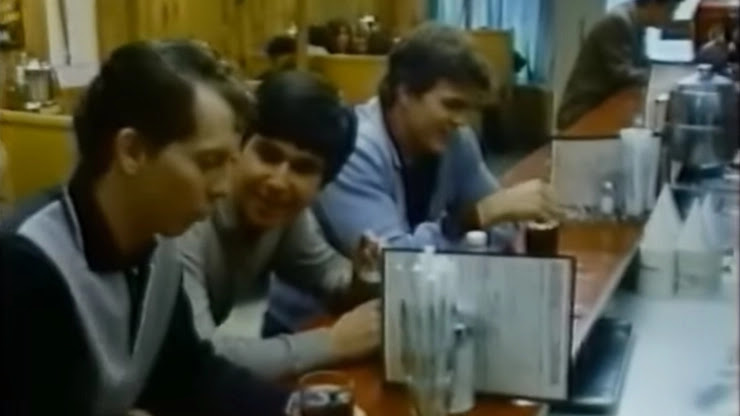
Ralph (Jerry O' Connell- Stand By Me) and his buddies, Flick (Cameron Johann) and Schwartz (Ross Eldridge) endure the incessantly cruel boredom of waiting at the employment office to finally obtain their working papers which Ralph has been eager to have. 
To them, work leads to wealth.  
They finally get their papers and find an opportunity for gainful employment at Scott's Used Furniture Palace.
They're quickly interviewed by Scott himself (Jean Shepherd), whom Ralph describes as a cross between Rasputin and the Wolfman. All three of them are hired on the spot, fueling each of their fantasies of wealth. 
They all celebrate their victory with a soda and talk about what they'll do with the heaps of money they think they're all in for.
Meanwhile, as Ralph shares the news with his family at the breakfast table that he's joined the working class, the family dog Fuzzhead hasn't returned home from his usual morning stroll to...wherever he wanders each day.
Mrs. Parker (Dorothy Lyman - Mama's Family) starts to worry. She tells Mr. Parker (James B. Sikking - Hill Street Blues) that she won't go on the family trip without Fuzzhead. 
James Sikking, Jerry O'Connell, and Dorothy Lyman in
Ollie Hopnoodle's Haven of Bliss

Meanwhile, clocking into their first day at the Used Furniture Palace, the boys are told to haul a heavy refrigerator up several flights of stairs in an apartment building. It's a scene reminiscent of Laurel and Hardy shoving a piano up a long flight. As they struggle, sweat, and swear, it's clear this isn't what they had in mind when joining the ranks of the working class.
Meanwhile, Mrs. Parker makes several "lost dog" posters with some of Ralph's brother, Randy's (Jason Clarke Adams) crayons, and posts them around town.
She offers a reward, though isn't certain what that reward will be.
Soon, people from all over Hohman, Indiana stop by their front porch with all kinds of dogs. Sadly, Fuzzhead isn't among them. 
Elsewhere, sore in parts he didn't know could actually become sore, Ralph has a nightmare about a looming refrigerator haunting him in his bedroom.
The next day, he and his two coworkers have to lift the same kind of fridge up another set of apartment stairs. Being a "galley slave" is hell after all, despite the paycheck.
For two weeks, Ralph works under the thumb of Scott in his palace of used furniture only to meet with the fate of being fired - $2 deducted from his paycheck for the work gloves. 
Later, while out driving, Mr. Parker spots Fuzzhead in the back seat of a luxurious Rolls Royce driving in front of them.
He chases the car down to a huge estate where a wealthy woman gets out with Fuzzhead.
At first, she's reluctant to give up her newly found poopsy-woopsie, but realizes it's best the dog goes back with its rightful family.
And Fuzzhead is left with his memories of the decadent life of prepared steaks and soft pillows as he returns to cheap canned dogfood and sleeping on the floor.
As the family is ready to take a trip, but worried how they'll manage to do so with Ralph's job, he tells them at dinner that he quit. 
When they ask why, he says he wanted to spend more time with his family.
So, they pack up the Chevy Sedan and head to a cabin at Clear Lake near Lake Michigan. 
Mr. Parker is anxious to catch some fish. And Mrs. Parker is anxious to just get away.
Their road trip includes the common setbacks such as the persistent whining from the kids, Randy's car sickness, Mr. Parker running out of gas because he'll only fuel up with Texas Royal Supreme Blue gasoline, and Mrs. Parker stopping at roadside shops and stands for useless kitsch décor. On top of all that, Ralph admits he forgot to pack the fishing tackle. 
When they finally make it to Ollie's Haven of Bliss cabins and campsite, they stay at the cabin named "Maria" as they're accustomed to. But Mr. Parker learns the fish have stopped biting.
Ollie Hopnoodle's Haven of Bliss is a wistful movie than utilizes some of the same style as A Christmas Story. 
In one scene Ralph breaks the fourth wall for a brief moment as Shepherd narrates what he's thinking, just as he did in the Christmas movie. 
In another scene that might be the only nod to A Christmas Story, the Old Man gets a flat tire. Ralph sticks his head out of the car window and asks "Can I help?" 
Mr. Parker responds with, "Are you kidding me?" 
I also caught another scene scored with music from Sergei Prokofiev's Peter and the Wolf, just as A Christmas Story did.   
The actual vacation half of the movie felt a little like a diluted National Lampoon's Vacation (1983), though much of the content is based on stories by Shepherd that were first published in Playboy magazine back in the 1960s. They were later published in his collection of short stories called Wanda Hickey's Night of Golden Memories in 1971, 
The movie is a bit corny at times. I still find it entertaining enough with several relatable scenarios and anecdotes.
I can imagine fans of A Christmas Story finding the most joy out of this film. 
The cast is well assembled, making the story of the all too familiar family road trip synonymous with comedy. It's a decent enough follow-up to the holiday classic regardless if it intends to be a follow-up or not.
Sikking plays Ralph's Old Man in a style that closely resembles Darren McGavin's performance in A Christmas Story.
To most audiences, McGavin is "the Old Man." 
Sikking fills the role well, with an ever-present look of confusion mixed with stern intent on his face. 
I also liked the relationship depicted between Ralph and his father. There seems to be a little more closeness between the two. 
Considering that Ralph's dad bought him his coveted Red Ryder BB gun in the previous film (the one person he didn't directly ask) it's a nice, subtle touch for the two to have a little closer relationship.   
Shepherd knows how to capture the world through the eyes of a kid facing the hard truth, with no soft way of putting it, that despite all of our plans and goals and fantasies, life is way too heavy for us to force and push it in the direction we want it to go. Only by luck or by chance will it cooperate with our demands.
It's the daily grind that makes vacation glamorous. The more we work, the more we yearn for and appreciate vacation. You can't have rest and relaxation without putting in your 40-hours a week. 
For many, the trek to our vacation spot is half of the burden.

Sunday, January 10, 2021

The Star-Crossed Romance of Josephine Cosnowski (1985)


Director
Fred Barzyk

Cast
Jean Shepherd - Adult Ralph Parker
Peter Kowanko - Young Ralph
Katherine Kamhi - Josephine Cosnowski
George Coe - The Old Man
Barbara Bolton - Mrs. Parker
Jay Ine - Randy

(SPOILERS)
Boy, I really lucked out this Christmas. I didn't receive many gifts, which is alright by me because I asked for little. What I did tear into (literally) on Christmas morning was more than I expected. 
I don't know how she did it or where she found it, but my loving wife found a DVD collection of hard-to-find Jean Shepherd films. In fact, the quality of these films suggest they were copied from VHS copies.
As I've stated before, Shepherd is the Norman Rockwell of story telling. His autobiographical character Ralph Parker, made popular by the 1983 holiday staple A Christmas Story (not included in the collection) has been depicted elsewhere on television a few times before the Christmas movie's release, and afterwards.
A company called "Onesmedia" compiled this collection of films, television programs, documentaries, narrations, and the like from Shepherd. It even includes the next couple of films I intend to watch and comment on for this unofficial Jean Shepherd movie extravaganza.  
Those other movies I've critiqued previously, based on Shepherd's writings, includes The Phantom of the Open Hearth, The Great American Fourth of July and Other Disasters and My Summer Story (aka It Runs in the Family). But I'm not done. There's a few more movies out there centered on Ralphie Parker like this one from 1985.
The Star-Crossed Romance of Josephine Cosnowski was the first movie (albeit a made-for-TV movie) about Ralphie to be released after A Christmas Story. I don't think it's much of a stretch to say this is the first sequel, technically speaking. It wasn't advertised as such, but it is the first production about Ralph Parker to be released after A Christmas Story.
My blog readers may have seen my small tirade about the 2012 movie A Christmas Story 2 boasting to be the first official sequel. Despite Christmas being over, I still plan on reviewing that movie hopefully before February 2 - the official day when the Christmas season ends. 
The Star-Crossed Romance of Josephine Cosnowski aired on PBS's American Playhouse just as The Great American Fourth of July and Other Disasters. And like these movies, including A Christmas Story, it's narrated by Shepherd playing Ralph as an adult. 
The movie centers on Ralph's (played this time by Peter Kowanko) romantic fling with the girl next door, Josephine Cosnowski (Katherine Kamhi). 
Katherine Kamhi as Josephine Cosnowski

Directed by Fred Barzyk, who also directed Phantom of the Open Hearth, there's a bit more drama in this than previous productions. It still possesses the same humor and fondness of those small joyous ups and unavoidable downs we still look upon with a certain fondness and bittersweet sentimentality. 
These depictions are what makes Shepherd's stories distinct and relatable. 
This story in particular is based on Shepherd's collection of stories called Wanda Hickey's Night of Golden Memories and Other Disasters. 
The audience follows a teenage Ralph at Thanksgiving time - the holiday best known when, as Shepherd narrates, "down the tubes [go] countless diets."
Those hillbilly neighbors, the Bumpus's and their 785 smelly hound dogs (as referenced in A Christmas Story) finally move out of the house next door leaving behind trash in the yard and unpaid rent. The Cosnowskis, a Polish family from East Chicago, move in. Much to the pleasure of Ralph, they have a teenage daughter named Josephine. 
Sure, the smell of stuffed cabbage permeates into the Parker house from those Cosnowskis next door. But that doesn't matter for Ralph. Josephine lives so close! 
"Polish girls were the stuff of legend in our set," Shepherd narrates. "Exotic. Remote. The line of the alien and foreign is always strong. We used to take Flick's car and ride through the Polish neighborhood just to see the girls on summer nights." 
Ol' Ralph frequently makes it a point to walk past Josephine's house on his way home from band practice, hauling his Sousaphone like a marching soldier hoping she spots him from her bedroom window. 
He's completely enraptured by her charm, gentleness, simplicity, and beautiful features. And to his luck, Josephine is just as smitten with him. 
The two are constantly side by side. 
After dating for a while, Josephine asks him to join her family for a Thanksgiving party which happens to be on the same night as the highly anticipated Hohman Highschool basketball game at the Civic Center. 
Still, Ralph goes to the party held in the basement of the local Catholic Church. 
He's not only introduced to her mom and dad, and two brothers simply referred to as "Killer" and "Buzz" who play football for Notre Dame, he's also introduced to her uncles, aunts, cousins, family, friends, and the parish priest. It's clear to Ralph her family assumes his romance with Josephine is an absolute prelude to marriage. 
Earlier in the movie, Ralph, Flick, and Schwartz meet up with their buddy, Howie. Shepherd tells us Howie left a potentially promising future as he was Hohman High School's basketball MVP, to marry young and have a baby. Now, he's forced to work long weeks to make ends meet. 
At the party, while Ralph is plating a dish of kielbasa and stuffed cabbage for Josephine, Howie follows him to the food table and warns him to keep his freedom before it's too late.
"She introduced you to the priest! Don't you know how that means? Her relatives! That's how it happened to me. Run for it, man. Now!"
These movies have lines that are just as memorable and quotable as those from A Christmas Story.
Ralphie ditches his food, and makes a break for it. After all, he wanted a date! Not a wife.  
Killer and Buzz see him take off and know exactly what he's doing. They chase him down until Ralph makes it to the basketball game were he joins Flick and Schwartz in the stands to catch the last few minutes. 
"Boy, it was good to be a kid again," Shepherd says. 
Ralph has his first face-to-face encounter with adulthood. It's certainly not watered down. Encounters with adulthood never are. 
Adulthood grabs him by the collar as if it's giving him an ultimatum. If he wants to be with his girl for life, he's going to have to pay for it with a load of responsibility. Or, he can sacrifice it for a few more years of childhood freedom. "Well, kid... what's it gonna be?"
Meanwhile, for Ralph's Old Man, it's hunting season for a new car. 
As we learned from watching A Christmas Story, the old man "loved bargaining as much as an Arab trader, and he was twice as shrewd." 
He takes his business to "Friendly Fred's" auto dealership, a place he's patronized many times before. 
I have the impression Fred is a caricature of Groucho Marx - a poor man's Groucho. I found him too cartoonish for the movie. 
Of course, as the story takes place in the 1950s, this was the era of Groucho and his weekly quiz show, You Bet Your Life, sponsored by DeSoto Plymouth.
"Go down and visit your DeSoto Plymouth dealer today. And when ya do, tell 'em Groucho sent ya," he'd close his show with. 
The comedy in this production is slightly overtaken with drama, especially in the first half when compared to those previous movies I've mentioned. This time the best of the comedy is saved up for the second half. 
Shepherd's humor can be described by the phrase, "isn't it funny that..." 
The humor here is in teenage romance. For any teenager, current or former, romance is a serious time. But years down the road when we have the vantage of seeing it from the outside looking in without the optimism seen through jade-tinted specs, the humor stands out on its own. 
The Star-Crossed Romance of Josephine Cosnowski seems to struggle a bit for content to fill the time frame. But it does pay off by the last act. That's when I found myself laughing the most, and nodding my head as I muttered "Yep...so true" to myself.  
We can only imagine what happens to Ralph and Josephine after the final scene. That's left to our imagination.
(L to R) William Lampley as Flick, Jeff Yonis as Schwartz and
Peter Kowanko as Ralph
Also, the Old Man ends up trading in his Oldsmobile for a car that starts tossing the Parkers up and down like pebbles as they drive it home. 
The Old Man refuses to go back and get his Olds back. 
"You can't do that," he tells Mrs. Parker, who insists on returning their car, getting their trade-in and their money back.
But go back they do, and Mrs. Parker comes out of Friendly Fred's office with their money and the keys to the Oldsmobile. 
Also, Ralph's kid brother, Randy (Jay Ine), has to play a turkey in the school pageant about the first Thanksgiving. It's a role he's stuck with, much to his chagrin.  
But Mrs. Parker, along with the help of her Bridge playing friends, is able to make a costume for him. Despite his huge displeasure for being cast as the bird thanks to his teacher, Ms. Shields's alphabetically ordered casting decisions, his performance receives a standing ovation. It becomes his greatest accomplishment ever. 
Ine's performance is nothing to praise. Children can certainly be great actors, but Ine just seems like he was cast at the last minute. He couldn't even produce a convincing scene when Randy starts balling to his mother about his role in the school play. It's pretend time rather than acting.
This movie helps make the characters we've seen in previous productions more well-rounded. Even in Randy's case, we have more insight into their mannerisms and reactions to the world around them. 
Barbara Bolton returns from the previous American Playhouse productions from Shepherd, as well as Jay Ine. William Lampley returns as Flick, and Jeff Yonis as Schwartz. 
George Coe replaces James Broderick as the Old Man. 
Broderick sadly passed away in 1982 shortly after The Great American Fourth of July and Other Disasters. 
The Old Man is famously played by Darren McGavin in A Christmas Story - a portrayal which has been branded in my head so permanently that it's difficult for me to see anyone else in the role. 
While both Coe and Broderick are enjoyable as Ralph's Old Man, I'm rather bias as his dad is my favorite in A Christmas Story. 
McGavin plays him so naturally and fittingly. And watching the movie at least once a year for the past 35 or so years of course would leave such a bias. 
Still, I did enjoy Coe's performance which was just as gruff, stubborn and above all, genuine as audiences know the character to be thanks to McGavin. 
And speaking of further insight, Ralph as an ambitious teen in the realm of romance, skidding too close to adulthood only to cling to kid-dom for safety while its still there to be clung to is funny to watch. Who hasn't contemplated their teenage ways of gaining love, only to inwardly cower in embarrassment when they think about the things they did to at least acquire a crush's attention? It's well played here. 
We don't get much dialogue from young Ralph as Shepherd does it all through his narration. I don't know if it's intentional, but it makes young Ralph appear dopey. Of course, "dopey" fits well with a love struck teen, so it works. 
Regardless, it's another fun watch especially in the second half. Shepherd's humor and brilliance for story telling is what kept me interested along with relatable scenarios such as Ralph's walks past Josephine's hoping she'll see him. Why? Just to notice he exists! 
Sadly, we're not treated to any initial meeting. One moment, Ralph is in love. The next, they're a hot item. It's not necessarily crucial, but it may have been a great opportunity to see Ralph stumble over himself over the girl of his dreams. 
The movie keeps the Shepherd banter and cleverness throughout. And it's another movie that deserves more attention, especially among A Christmas Story fans.  
Despite Christmas day having come and gone, we are still in the Christmas season (a perk of being a Catholic). I still have A Christmas Story 2 to watch as well as Ollie Hopnoodle's Haven of Bliss. Those are on their way.

Thursday, December 3, 2020

The Great American Fourth of July and Other Disasters (1982)


Director
Richard Bartlett

Cast
Matt Dillon - Ralph Parker
James Broderick - The Old Man
Barbara Bolton - Mrs. Parker
Jay Ine - Randy
Babe Sargent - Ludlow Kissel
Jeff Yonis - Schwartz
William Lampley - Flick
Lisa Jacobsen - Pamela

With the pre-Christmas season upon us, my look into the "other" films of A Christmas Story's Ralphie Parker and the Parker family continues from my last posted review of The Phantom of the Open Hearth (1976). 
The Great American Fourth of July and Other Disasters aired on the PBS anthology series "American Playhouse" one year before the famed A Christmas Story was released in theaters and was initially labeled as a "sleeper film." By the way, movie critic Roger Ebert gave A Christmas Story four out of four stars and placed it on his list of "Great Movies." 
While watching this PBS film, I found myself falling into the same temptation I had while I sat and watched The Phantom of the Open Hearth.
Listening to Jean Shepherd narrate once again (his writing and wit I admire greatly), I wanted to scribble down all his words on paper. Of course, I didn't do that. Nevertheless, within the first three minutes of the movie I still managed to have a full notebook page of thoughts and things I wanted to say for this blog entry. My pen couldn't keep up with my mind's pace. 
Barbara Bolton and James Broderick return from The Phantom of the Open Hearth, which originally aired on another PBS anthology series called "Visions" as Mrs. Parker and the Old Man. 
A young Matt Dillon stars as Ralph Parker this time. He was last played by David Elliott. 
The movie starts with Jean Shepherd as an adult Ralph cruising along I-95 on his way to a fireworks warehouse called "South of the Border", the likes of which can still be found along the highways in, out of, and through the American Midwest. Large industrial cathedrals of American pyro-patriotism at "low prices that'll make your head explode." A Costco-esque extravaganza of crackers, garlands, and Black Cats, glowing like votive candles in the American ritual of independence. 
"You know, this joint makes Disneyland look as prosaic as Plainfield, New Jersey," he tells us as we sit in the passenger seat while he's barreling in his Rolls. 
Jean Shepherd
Shepherd wanders through the aisles with a small shopping cart full of large fireworks protruding out as he tells the audience how these are nothing compared to the big ones the Old Man used to shoot off on the 4th. 
"What is it about a solid molar-rattling explosion that sets the blood a'tingle and brings roses to cheeks?" 
We find a teenage Ralph working at the steel mill of Hohman, Indiana (a fictionalized town based on Shepherd's hometown of Hammond, Indiana near Chicago) in the middle of summer. 
He fancies himself a handsome catch despite his lack of interest in his friend Schwartz's persuading him to go on a blind date with his cousin, Pamela (Lisa Jacobsen). 
Ralph anticipates Pamela to be a more rotund figure with braces and thick glasses. Certainly not his type. 
Meanwhile, his Old Man buys an entire arsenal of fireworks for the July 4th spectacular. And Ralph has to practice for the local Independence Day parade as he's playing a sousaphone in the Hohman High School Marching Band.  
As Ralph agrees to go on this blind date, Pamela turns out to be a stunning blond gal. Along with Scwartz and his girlfriend, they all go to the movies for the evening. Ralph makes a klutz of himself by spilling his box of Good 'n Plenty on the floor when he's introduced to Pamela. His charming self-image comes out as awkward. During the show, Ralph doesn't help his awkward situation when he tries to pull the ol' arm around the shoulder bit. 
But Pamela puts the kibosh on that suave move when she tells him "don't be a child." Skunked!
Meanwhile, Mrs. Parker enters some sort of chain letter situation where she sends her washrags to someone else for reasons I couldn't quite figure out. This is much to the chagrin on Mr. Parker who can't find a single one to wash his face. But she suddenly inherits 17,900 washrags as a result of this chain.
And during the parade, the marching band's baton twirler accidentally launches one of his batons on to some power lines, causing a blackout across Hohman. 
The movie showcases the typical Americana happenings around the July 4th holiday with the same charm and reverence A Christmas Story does with the holiday season, and Ralphie's attempt to acquire the best Christmas gift he ever received, or would ever receive. 
There's a few quick familiar references fans of A Christmas Story will pick up on. For instance Ralph's little brother, Randy, asks his mom if he could buy a cherry bomb, only to be handed that famous line A Christmas Story managed to permanently fix into the cornucopia of movie catchphrases. In this case, it's the classic mother cherry bomb block - "You'll shoot your eye out." 
In the previous film, we saw the Old Man win his major award. This time, Mrs. Parker has her moment of success with her washcloth inheritance. She even gets her picture in the paper. A sulky dad stares at his wife, glowing with success, as Shepherd tells us, "The old man was really bugged. She won! She was famous for God's sake. The only thing he ever won was a stupid lamp, and nobody cared." 
And perhaps my favorite line in the movie was in reference to how much Randy could pull off whining, especially when it came to unwanted meals. 
His incessant mewling and whimpering is referred to as an "artform." 
"You wanted to kill him," Shepherd says. 
This, obviously, is referred to again in A Christmas Story when Randy (played by Ian Petrella) is enticed by his mother to imitate a little piggy so that he'll eat a plate of meatloaf he's otherwise disgusted by.
We're also treated to the story of Ludlow Kissel, the town drunk, and the incident of the bomb that "struck back." 
Matt Dillon as Ralph Parker
A perfect companion film to Phantom of the Open Hearth as it, too, turns the words of Shepherd into imagery of simplistic, glorious, American life and the freedom that comes with it. 
It's a view from the outside looking in, and Shepherd tells us in the audience to look at what we have here. How terrific it all is!
One scene shows the high school marching band practicing out on the football field as the steel mill sits monumentally just on the other side of the fence. Strong winds blow in from Lake Michigan with such intrusion and gusto, catching the sousaphones just right so that they start playing the students. 
Dillon's portrayal is certainly a stretch from Peter Billingsley's Ralphie, who's now an established image in American pop culture. Or, maybe it's the other way around as Billingsley's Ralphie didn't happen until the following year. That's certainly not a criticism. Of course, Ralphie in A Christmas Story is still in elementary school, and has his childhood innocence and blue-eyed look about him. It's the same role, but a different period of his life. The Ralph in The Great American Fourth of July and Other Disasters is much more present for the sake of Shepherd's narration. The stories are more memorable than Dillon playing Ralph. That's not to say he's a terrible Ralph Parker. Shepherd does more of the acting for him.
This is also James Broderick's last performance as he passed away the same year.
I was excited watching this movie. I was getting a whole new look at something I'm familiar with, and have loved for a few decades. Now, there's more to the story. There's more experiences with these familiar characters to appreciate and learn from. There's more to relate to. 
The Great American Fourth of July and Other Disasters, though it clearly has that early made-for-TV feel to it, still has the same style and nostalgic charm that A Christmas Story has. All the same feels are there, only it's surrounding our nation's birthday rather than Jesus'. 
Like I said in my previous review, fans of A Christmas Story should check this one out. It's too bad this film is as obscure as it is. These are the movies that ought to be packaged with A Christmas Story!

Editors Note:
The next movie in the Ralph Parker saga (as I'm calling it) is another American Playhouse production called The Star-Crossed Romance of Josephine Cosnowski. Originally airing on PBS Feb. 11, 1985, it's technically the first continuation to A Christmas Story. 
After that, I'll be looking at the made-for-TV movie Ollie Hopnoodle's Haven of Bliss which aired in 1988, and has been shown on the Disney Channel several times as well as on PBS. Following Ralphie and his family as they travel on their annual vacation, it too was directed by Richard Bartlett. I already wrote a review for the 1994 sequel to A Christmas Story called It Runs in the Family (aka My Summer Story) starring Kieran Culkin as Ralphie and Charles Grodin as the Old Man.
I'll end this exciting escapade by holding my nose and diving into the sludgy cash-grab of a flick that is A Christmas Story II. I'll have to do it fast so it won't hurt as bad...like tearing off a band-aid. So, that's the plan. Merry Christmas!  

Thursday, November 12, 2020

The Phantom of the Open Hearth (1976)

Fred Barzyk and David R. Loxton

Cast
David Elliott - Ralph Parker
James Broderick - The Old Man
Barbara Bolton - Mrs. Parker
Adam Goodman - Randy Parker
William Lampley - Flick
Roberta Wallach - Wanda Hickey


I was meandering around the internet looking through movie websites when I stumbled upon a reference to a 1988 made-for-TV movie called Ollie Hopnoodle's Haven of Bliss. 
It sounded like something I could easily pass over. But one thing about it caught my attention. 
This forgotten TV movie, it turns out, might be the first sequel to the 1983 Christmas staple that is A Christmas Story which is based on the book In God We Trust, All Others Pay Cash by Jean Shepherd. 
Last April I posted a review to a 1994 comedy called It Runs in the Family (aka My Summer Story) which I mistakenly claimed is the first official sequel to A Christmas Story. I was irked, and still am, that the 2012 film A Christmas Story 2 claims to be the "official sequel." I'll deal more with this lie in a later post. 
Anyways, how wrong I was about My Summer Story. And I'll review Ollie Hopnoodle's Haven of Bliss in the weeks to come.
But as I dug a little deeper in trying to find a way to watch this TV movie, I made another discovery. 
In 1976, there was in fact a TV movie about Ralphie Parker (the main character of A Christmas Story) and his family also based on the works of Shepherd. Like A Christmas Story, it's narrated by Shepherd himself. 
This is The Phantom of the Open Hearth.
Incidentally, there was another made-for-TV movie released in 1985 (two years after A Christmas Story) called The Star-Cross Romance of Josephine Cosnowski which centers around Ralphie and the other characters from A Christmas Story. It, too, is based on the works of Jean Shepherd. I haven't watched it yet as I write this, but it might actually be the first sequel, technically speaking. Consider that last statement a disclaimer.
Directed by Fred Barzyk and David R. Loxton, Phantom of the Open Hearth was shown on a program called Visions- a weekly anthology series of original dramas and such that aired on PBS.
Barzyk would later direct The Star-Crossed Romance of Josephine Cosnowski which aired on another anthology series called American Playhouse. I'll watch and discuss that movie as well.
Loxton later directed the late, great Raul Julia in an American Playhouse production called Overdrawn at the Memory Bank (1983). Fans of Mystery Science Theater 3000 should be familiar with that oddity. 
The Phantom of the Open Hearth stars David Elliott as Ralph Parker along with James Broderick (Matthew Broderick's dad) as "the old man," Barbara Bolton as Ralphie's mom, Adam Goldman as Randy Parker, William Lampley as Flick, and Bryan Utman as Schwartz. 
The story takes place in 1950s Midwest (A Christmas Story is set in Hohman, Indiana) and of course centers on Ralph, a high school teenager, as he musters up courage and a plan to ask Daphne Bigelow to the Junior Prom. Off to the side, Wanda Hickey would sure like to go with Ralph. After all, she's had a crush on him since they were kids. 
Throughout the story, as Ralph fawns over Daphne and daydreams about taking her to the dance, other events are occurring in and around his typical teenage life.
For instance, his old man wins a "major award" (does that sound familiar?) which turns out to be a lamp in the shape of a woman's leg. And just like the infamous leg lamp of A Christmas Story, it meets its shattering demise after Mrs. Parker knocks it over. Was it an accident? Or was in an "accident?" 
Ralph also takes part in a church baseball game that turns into an all-out brawl. 
And lastly, his mother visits the local Orpheum movie theater each week as the theater manager gives away complimentary movie star tableware... the "dinner service of the stars." But due to a continual oversight, the weekly shipments turn out to be nothing but gravy boats week after week. 
Despite continual empty promises that the problem will be corrected and movie goers will receive their new dinnerware the following week, the audience full of angry housewives decide they've waited long enough. During the final theater scene, they chuck their 3rd, 4th, or 5th set of free gravy boats at the theater manager on stage, resulting in a cacophony of exploding china. 
James Broderick (left) as 'the old man' and
David Elliott as Ralph.

This same scene would later be reenacted in My Summer Story.
So, Ralph decides to ask Wanda to the prom despite his fawning for Daphne. as well as Wanda's simple appearance, Coke bottle classes, and neck-length curly black hair. Bravo, Ralph.
And it all goes smoothly until he, Schwartz, and Flick take their dates out to dinner after the prom. The night begins to turn sour as he leaves the roof of his dad's Oldsmobile down during the prom, while the sky decides to open up and pour, flooding the Olds.
The Phantom of the Open Hearth gives more insight into Ralph Parker. Though it came out eight years before A Christmas Story, it works in solidifying Ralph as a character, and provides more insight into his relationship with his "old man." 
It compliments A Christmas Story nicely in establishing a little more depth to the world of the Parkers. That's not to say A Christmas Story fails in anyway in establishing relatability or insight. Obviously, they're likeable characters the audience quickly relates to and cares about. The movie is still very popular, after all. 
This movie simply goes more into that by portraying these characters in different situations, and how they interact with their world around them. We're also introduced to different characters not portrayed in A Christmas Story. 
Of course, it's really A Christmas Story that gave audiences all that as it came out afterwards. I'm thinking backwards since this is the first I've heard of The Phantom of the Open Hearth.
It's the mind and wit of Jean Shepherd that ties these stories all together. 
If you haven't read Jean Shepherd, he's the Norman Rockwell of the printed word and of radio, having been a long-time radio personality. 
The character of "Ralph" acts as his eyes to Americana, down to the small, perhaps often overlooked joys and perks of life that are the glitter of freedom and patriotism. 
Watching this movie and listening to Shepherd narrate - his voice so familiar to me having watched A Christmas Story at least once a year for the last 35 years - I wanted to write down all his wonderful descriptions while he narrates as adult Ralph. 
For instance, in the movie he describes the "then and now" as "the glorious past and the crummy now." 
When we learn of Ralph's teenage crush on the beautiful Daphne Bigelow, Shepherd reminisces to the audience, "Even now, I can't suppress a fugitive shiver of tremulous passion and dark yearning." 
What a way to say, "yeah...I still think fondly of my old crush." 
That's what makes Shepherd a true classic in American literature and media. He is a genius when it comes to humor and narration. 
He has such a unique way of making the small things in life - a baseball game, a high school prom, that coveted toy we wanted so badly for Christmas, and the work that went into persuading our parents to get it - and distilling in the audience a sense of  relatability, nostalgia, and appreciation. 
He can craft a curious story around such simple things, turning them into events of great importance worthy of long lasting fondness. They're simply the things that remind us of how great life in America is. It's the "glorious past" which is begins in our "crummy now."
Everyone surely had a "Wanda Hickey" in there life who didn't go to the dance with them, or a memorable high school sporting event where something truly memorable happened like a team fight out near the shortstop. There's positivity in negativity - sometimes. 
Again, I wanted to write all his comments down while watching this, and I could have easily done so. 
Oh, and that infamous leg lamp... the movie has a more solid backstory as to what that image is all about.
I mentioned this in my previous post about A Christmas Story. That sexy leg, like on a statue. Yeah! A statue! It's a logo for Nehi (knee-high) soda. The "old man" drank it like water. 
So, the leg is one big ad for a soda. 
David Elliott as Ralph Parker.
"There it was. Nehi orange! It was so spectacularly gassy that violent cases of the bends were common among those who gulped it down too fast. It would clean out your sinuses faster than a Roto-Rooter," adult Ralph narrates in the movie. These lines are catchy just as his lines in A Christmas Story such as when he narrates in the latter film, "Only I didn't say 'fudge.' I said thee word. The big one. The queen mother of dirty words. The 'F dash, dash, dash word."
Shepherd's appreciation for life is drafted well in both movies. Each phrase of his is like a small love note to the past. 
Organ music serves as most of the soundtrack in various scenes. It's a little awkward and dated, but reminiscent of Shepherd's radio days. 
His radio stories were often accompanied by an organ like it would for a silent movie, to emphasize emotion - trepidation, failure, love, glee. 
The scene with Ralph volunteering to play on a church baseball league is fun to watch but doesn't serve much purpose to the overall story. It's just an event that happens as it leads to a team fight. It fits in style and wit, but felt like content filler. 
Maybe style is why it's included. After all, like A Christmas Story, it's a small detail about American homelife from an honest vantage point. Even in the good ol' days, fights broke out at church baseball games. 
Life was life back then, and still is in the "crummy now." That alone deserves attention and, maybe, some appreciation for whatever lessons we draw from it. We're all immersed in it.
In the end, after the prom, Ralph, Schwartz, and Flick take their dates out to a fancy dinner where Ralph orders a triple without any knowledge of what that actually consists of. He only knows "a triple" because he's heard his old man order the same drink over and over again.
Flick and Schwartz, just as ignorant as Ralph, order the same. 
With his first glass, he falls headfirst into the surreal realm of intoxication. The dream-like camera angles portray his drunken stupor, which is broken with quick scenes of an erupting volcano. 
Two triples in, the three boys soon find themselves crammed and huddled in a small bathroom stall puking up all their fun, and maybe some of the leftover fun from earlier in the week. The glory days weren't always glorious.  
Also, I read online that Ralph utters the famous line "oh, fudge" somewhere in this movie. I didn't catch that, but maybe it's in there. I watched an uploaded version of this movie on YouTube which was clearly recorded off television at some point. 
Anyhow, it's a shame Phantom of the Open Hearth is as obscure and forgotten as much as it is. Thankfully, it's not a lost film. 
Surely fans of A Christmas Story and Jean Shepherd should see it for themselves. This is the movie to pair with A Christmas Story instead of that terrible "official sequel" from 2012. 
I didn't understand the title Phantom of the Open Hearth after watching this. Who was the phantom, and what did any of this story have to do with hearths? 
Well, the hearth was often considered the center of a home as it was the location of warmth, light, food, and safety. This was before cell phones came along. A phantom is another word for a ghost. 
So, the ghost of the heart of a home? I conjecture that it's a clever way of referring to the ghosts of the past. I'll have to think about this for a bit. 
   

Editor's note;
It has been an entire month since I've reviewed any movies on this blog. During the month of October, I focused all my movie watching and writing time to my other blog 1000daysofhorror.blogspot.com, and its accompanying Podcast at anchor.fm/1000daysofhorror. 
I have no intention of neglecting this blog. So, with Christmas starting to show itself, I plan to look into Jean Shepherd's Ralphie Parker films mentioned above, including the *gag* movie I swore I'd never watch - A Christmas Story 2. Yep! I'm going to watch it. 
I include part two among Jean Shepherd movies only because the characters are based on his work. The sequel's story isn't based on any of his writing. But if I'm going to lambast it, the least I could do is watch it. I'm a glutton for punishment, I guess.
So, having written my thoughts as to whether A Christmas Story is a dumb movie or not, as well as reviewing its sequel My Summer Story, I'll add in the other Ralphie Parker sagas The Great American Fourth of July and Other Disasters, The Star-Crossed Romance of Josephine Cosnowski, and Ollie Hopnoodle's Haven of Bliss. Here's to you, Jean Shepherd! 


Jean Shepherd (left) in A Christmas Story

Masters of the Universe (2026)

" Hang on, it's about to get weird. " Director Travis Knight Cast Nicholas Galitzine - Adam Glenn / He-Man Jared Leto - Skelet...