Thursday, October 24, 2019

Don't Fast Forward This One: Did Charlie Deserve the Chocolate Factory?

These "Don't Fast Forward" posts are my thinking points for specific movies. They're not meant to be reviews. 

The ending of Willy Wonka and the Chocolate Factory is probably nothing new to many people. And that probably goes for the previous hour and half, too. 
The movie is far from being an obscure picture. Very much the opposite. So, my take on the ending is probably bleedin' obvious.
But I've heard arguments claiming the end of Willy Wonka and the Chocolate Factory taught an objectionable lesson. Some argue Charlie Bucket, the protagonist of the movie, is rewarded for "bad behavior" which is a terrible lesson for the film's young audiences. But is Charlie actually rewarded for bad behavior? 
This argument bugs me a bit because it's one of those opinions I know isn't the case.
In any good story, the protagonist needs to have a flaw they need to overcome. Otherwise, they usually have something they're trying to achieve or accomplish. There ought to be some kind of imperfection or struggle. It makes the character more relatable and gives the audience a sense of hope that no matter what sins we've committed in our past, all is not lost.
In Charlie's case, his misdeed is a rather small one, but it's a misdeed none the less.
During the tour of Wonka's factory, Charlie and his grandpa Joe decide to lag behind and take a swig of some bubbly "fizzy lifting drink" Wonka previously said wasn't ready for consumption. He instructed his visitors not to drink any. 
As they chug, the gas causes them to float higher and higher. At first, it's fun, until they float dangerously close to fan blades in the ceiling.
They both cling to the sides of the wall to avoid getting caught up there, until Grandpa Joe realizes that burping will release the gasses, and they'll float back towards the floor. They both think they got away with it, until the end of the movie.
There's also a point in the movie when Wonka shares a secret candy with his visitors - Everlasting Gobstoppers. It's a candy that won't dissolve no matter how long people suck on them. They're "everlasting!"
He makes each child promise not to let theirs fall into the hands on his adversarial competitor, Slugworth, as that would lead to Wonka's ruin.
At the end of the movie (SPOILER for those living in caves over the last 40 or so years and haven't seen this movie), when Charlie goes to collect his lifetime supply of chocolate promised him when he found the Golden Ticket, Wonka refuses and calls both of them out for breaking the rules by stealing some of his fizzy lifting drink. He tells them that they've both touched the sterile walls which now have to be sanitized. And according to the huge contract Charlie signed before the tour, the promise of chocolate is null and void as a result.
"You get nothing! You lose!" he shouts at Charlie and his Grandpa Joe.

Grandpa Joe grows angry and vengeful calling Wonka a crook and tries to retaliate by telling his grandson, "C'mon Charlie, if Slugworth wants a Gobstopper, he'll get one!"
As Charlie already broke a rule, he's not about to break a promise.
Instead, he defies his own grandfather and through his actions admits what he did. He turns back to Wonka, and hands him his Gobstopper. Why? Because Charlie knows he doesn't deserve it for breaking this one rule. 
In my more youthful days, I saw this as Charlie losing his appreciation for Wonka. I thought his returning the Gobstopper meant he simply didn't care for him anymore. But that really doesn't make sense as it would be a really conceited action. Though Charlie isn't a perfect child, he's certainly not so self-centered and dense like the other kids on the tour. 
Unlike the other kids who broke a rule or two, Charlie fesses up as expressed in his actions. That's what made him stand out above the rest.
"So shines a good dead in a weary world" Wonka says to himself when he's given back the Gobstopper.
As Charlie is honest and humble enough to take responsibility for his own actions, and give
something up because he knows he no longer deserves it, Wonka praises him. His honesty and integrity are just the sort of characteristics Wonka wants in a successor for his factory.
Wonka doesn't reward Charlie for stealing. He initially chastises him by denying him the reward - the lifetime supply of chocolate. 
Then he rewards Charlie for admitting to what he did and giving back what he was originally privileged to get but is no longer deserving of. A penitential act, indeed. Wonka didn't seem to mind as much when the other children defied his rules. He was more interested to see what they would do afterwards.  
If Wonka wanted an absolutely flawless child, he'd never find one.
Incidentally, this is something I hated, hated, hated in Tim Burton's remake Charlie and the Chocolate Factory. 
Charlie Bucket in Burton's version is portrayed as absolutely flawless. He's so squeaky clean, Charlie is left being completely unrelatable and unrealistic. I mean, he's so perfect, I'm surprised Burton's movie doesn't end with Charlie rising from the dead to redeem mankind. 
There are good kids, but no kid is flawless. Whether a child is a good child can be determined by how they deal with their shortcomings, and work to overcome them. This is what distinguishes Charlie from the other kids in the 1971 version, making him the better choice as a successor to Wonka. 
With Burton's movie, there's nothing for Charlie to overcome. Burton's Charlie just takes the tour, looks innocent and cute, watches the other kids get picked off one by one, and then gets his reward. Boring! No lessons. Nothing for audiences to take away. The entire movie is a hot mess. I commented on it in another post - "Charlie and the Chocolate Factory." 
The idea that Wonka simply rewards Charlie despite his misdeed completely misses the point of the ending. So, because of his honesty and humility, he deserved the factory when all was said and done.

Friday, October 18, 2019

Don't Fast Forward This One: Is Warren Beatty's Dick Tracy a Forgettable Comic Book Movie?

I came up with "Don't Fast Forward This One" posts as quick discussions about movies, or specific aspects to specific movies. They're not reviews...just thinking points.

I've read that Warren Beatty tried to get a movie adaptation of the comic strip Dick Tracy created by Chester Gould since 1975.
He finally succeeded in 1990. I was about second grade when Dick Tracy was released, and I was a fan. I even dressed as Dick Tracy for Halloween that year, with a cheap yellow trench coat and plastic fedora hat that had to be Scotch taped before Halloween arrived because I wore it too much before then. I even had a toy two-way wrist radio watch that digitally told time (I think?) and would light up red when pressing the small button on the side.
The movie is a fireworks show of color and sights. It looks like a modern film noir. I struggled unsuccessfully to come up with another movie Dick Tracy resembles. I couldn't find a single one, and I'm open to suggestions.
Dick Tracy came out a year after Tim Burton's Batman gave audiences a new perspective on the caped crusader, completely opposite of Adam West's campy Batman from the TV series of the 1960s. No doubt many audience members were unfamiliar with Frank Miller's dark Batman graphic novels at that time. These took comic book readers away from the corny 60s Batman before the movie took general audiences in that same direction. Burton, I believe, took inspiration from Frank Miller.
Aside from the cinematography, what makes Dick Tracy unique and important is (like Tim Burton's Batman) its demonstration of how a comic book movie can be a serious movie.
The movie is set around the 1940s. A small gang of mafia members (Little Face, the Brow, the Rodent, and Shoulders) are mowed down by a couple of tommy guns in the hands of rival gang members, Flattop and Itchy. Little do Flattop and Itchy know, this massacre was witnessed by a young street kid named..."Kid."
As Dick Tracy investigates, gangster "Lips" Manlis (Paul Sorvino) is forced to hand over his Club Ritz to notorious rival gang leader, Al "Big Boy" Caprice (Al Pacino). Big Boy then gives Lips a "cement bath" and then forces him to spend the rest of his days with the fishes.
Big Boy is determine to take over Lips's little empire, which includes his girlfriend, Breathless Mahoney (Madonna).
Tracy knows Big Boy is behind Lips's disappearance, but needs evidence and Breathless's testimony. What he uncovers in his investigation is bigger than he imagined.
The Dick Tracy comic strips first debut in 1931 by Chester Gould, before Superman and Batman.
They were colorful, silly, and offered a huge rogues gallery for Tracy to fight, each with a visually distinct characteristic stereotypical of mobsters - Pruneface, the Rodent, 88 Keys, the Brow, Lips Manlis, Ribs Macca, B.O. Plenty. The list is long. The idea behind these appearances is that crime is just as ugly on the outside as it is on the inside.
So, with the 1990 film, this silly and cartoonish comic strip became a movie experience that's gritty, even gory at times with scenes of criminals getting sprayed with bullets. It followed the example of Burton's Batman that a comic-based movie doesn't have to be corny or slapsticky.
Let's face it, the Superman movies had some of that. It didn't make those movies bad (well...the first and second Superman, anyways. Let's not talk about parts three and four.)
Dick Tracy demonstrated just how serious a comic movie can be. It's a triumph in its visuals, in its cast of big names (Al Pacino, Madonna, Dustin Hoffman, Warren Beatty...even Dick Van Dyke, James Caan, Catherine O' Hara, and Kathy Bates make cameos), and in its action special effects.
When the movie was released, Dick Tracy's profile was everywhere. Playmates produced a short lived toy line. McDonald's put out one of their sweepstakes games. Nintendo had a video game - a terrible video game! And then, it all just faded away into a footnote.
The story line has been often ridiculed as being uninteresting and lacking.
But Roger Ebert, who said Burton's Batman was "disappointing" called Dick Tracy a "masterpiece of studio artificiality, of matte drawings and miniatures and optical effects." He even claimed Dick Tracy outdid Batman, writing that it was a "sweeter, more optimistic movie."
He does criticize the movie not going into the villains a little more, claiming the movie glimpses over them too quickly. Well, ok...I agree to some degree but with all the villains in the movie, doing so could have been a little too much, and could have hindered the flow of the story.
What Batman started for comic book movies, Dick Tracy took to a new, and yet-to-be-matched, level. It may not be the best comic to movie adaptation. It is definitely far from the worst. Like Batman, it hoisted the genre to more respectable heights. Where Batman turned campy and silly into dark and gritty, Dick Tracy added color while keeping things dark. What Batman started, Dick Tracy helped solidify. I believe modern comic book movies (SpiderMan, The Avengers) can find roots in Warren Beatty's movie. It shouldn't be trodden on, and thrown into the heap of comic book film flops.


Also, as I mentioned the TV series Batman, the show's producer, William Dozier, made a pilot episode for a live-action Dick Tracy series that was similar in style to Batman.
However, as ratings for Batman were dropping at the time, ABC and NBC declined to purchase the series.
The show starred Ray MacDonnell as well as a very young Eve Plumb as a character called "Bonnie Braids." Plumb later stared as Jan Brady on The Brady Bunch.
According to tvobscurities.com, the series was going to be played straight when compared to Batman. Judging on the opening title sequence, found here, the series definitely looked like it would be similar to Batman. (Sigh...what could have been.)


Friday, October 4, 2019

Freaked (1993)

I wonder if they're still casting 'Gremlins 3?"

Director
Alex Winter and Tom Stern

Cast
Alex Winter - Ricky Coogan
Michael Stoyanov - Ernie
Megan Ward - Julie
Randy Quaid - Elijah C. Skuggs
Alex Zuckerman - Stuey Gluck

The term "cult" is used often to describe a lot of movies. I think it's often misused. "Cult" is meant to describe generally unpopular obscure films that manage to have a fan base for the simple fact they're bad or obscure yet still entertain.
For example, some audiences consider A Christmas Story to be a cult film. But the thing is, though it was a low-budget movie, and faded for a short time after its 1983 release, it's well established in pop culture now. It's by no means an obscure movie. Low budget doesn't mean cult.
Freaked is a movie I hadn't heard of until a few months ago. It definitely has a specific target audience- a specific group of fans. It's Airplane meets Tim Burton, meets Pee Wee's Playhouse, meets that weird animation scene Rob Zombie did for Beavis and Butthead Do America.
This flick cost about $13 million to make (mostly towards its special effects), but it only made back a little over $29,000.
According to IMDB.com, some audiences believed this was going to be a sequel to Bill & Ted's Excellent Adventure as it stars Alex Winter and an uncredited Keanu Reeves. It also stars William Sadler who starred as the Grim Reaper in Bill & Ted's Bogus Journey in 1991. They must have been sorely disappointed to learn that wasn't the case.
A lot of celebrities are in this movie - Brooke Shields, Randy Quaid, Megan Ward, Mr. T, and Bobcat Goldthwait, and a cameo by Morgan Fairchild.
I just cannot say it's a good movie, even if I believed it to be so. I just can't. I don't think it's meant to be a good movie. It's meant to be a comedy filled with gross-out humor, pseudo science fiction, with one liner after one liner and sight gag after sight gag.
There is so much happening here. And it definitely accomplished what it set out to do.
Directed by Alex Winter and Tom Stern, both of whom were in the Bill & Ted movies, it's a gross and a high energy movie.
Winter plays a former child star, Ricky Coogan, who shares his story on a talk show hosted by Skye Daley (Brooke Shields) of how he became so hideously disfigured...or, "freaked."
His story begins with his accepting a contract from a giant company called E.E.S. (Everything Except Shoes) that'll ensure he promotes a toxic fertilizer called Zygrot 24 in South America.
The E.E.S. CEO (William Sadler) offers Coogan $5 million, which he can't refuse.
So, Coogan flies down to the South American town of San Flan (snicker) with his buddy, Ernie (Michael Stoyanov). While on the flight, he finds his "number one fan" - a 12-year old Alfred E. Neuman looking kid named Stuey Gluck (Alex Zuckerman), He's constantly referred to as a troll throughout the movie.
Gluck begs Coogan not to promote the toxic stuff, but he ignores the pleas.
When they finally land in South America, they stumble across a group of environmental protesters.
Coogan sets his eyes on one cute protester named Julie (Megan Ward).
In an attempt to hook up with Julie, Coogan disguises himself as an accident victim, body bandages and all, and tells her they're also protesters.
She agrees to join them for another protest elsewhere. But as Julie is driving to the next location with them, she figures out it's really Coogan, and now she's stuck with them.
While driving, they decide to make a stop at Freek Land - a local freak show.
When they arrive, they end up kidnapped by the demented proprietor/ scientist, Elijah C. Skuggs (Randy Quaid).
Skuggs turns them into freaks using some green slimey chemical, and keeps them to show them off for his tourists.
While being held captive, they run into other freaks - Ortiz the Dog Boy (Keanu Reeves), a human worm (Derek McGrath), a cowboy that's really a human cow (John Hawkes), a bearded lady (Mr. T), and Sockhead, who actually has a sock puppet for a head (Bobcat Goldthwait), to name some.
Coogan explains in the interview how he and the others managed to escape Freek Land.
Among the stop motion special effects, the jokes and gags, and the makeup, what impressed me was Winter's makeup and dialogue. Half of his face was mutated, and the prosthetic teeth and lips kept him from being able to completely close his mouth. He clearly had to say his lines off-camera, so they could be dubbed in. There's no way he could have spoken coherently without being able to completely close his mouth. It is done so well. His tone matched his mannerisms and body language perfectly. It sounds like a small detail, but I'm sure filming a majority of the movie unable to close his mount was no small feat for Winter. His character drooled and spit a lot after being transformed. I read on IMDB.com that this excessive saliva was real, caused by the prosthetics.
I couldn't take my eyes off this movie. So much went into this movie, or so it seems.
One running joke that made me laugh was the "spiritual connection" between Coogan and Gluck.
Through this connection, Coogan is able to show Gluck what he's become, and Gluck makes a crude, childish drawing of what Coogan looks like, all "freaked-out."
He tries to take his drawing and his story to several major newspapers. As he does this, we see the silhouettes of Gluck and each news reporter through the translucent doors of each paper in a film noir fashion. Each one ends up physically throwing him through the glass on the door.
One newspaper does take the story, and offers to pay the kid. When the reporter tells someone off camera "show the kid out." Gluck responds, "I know the way out" and chucks himself out the window. It's funnier when you see it.
I never heard of this movie until about six months ago from the date of this post. I laughed a lot. I was overall entertained. And Alex Winter put a lot into this movie. Through the saliva and heaving makeup, it showed.
There are also two walking Rastafarian eyeballs with guns making sure the freaks don't escape. I'll just lay that little tidbit of movie fact right here, and let the reader deal with it themselves. I just can't explain this part of the movie. It's not lazy writing. I just can't get myself to do it without making it sound less sensical for the reader than it is. Again, two Jamaican eyeballs with guns are walking around FreekLand.
Freaked is definitely for a specific audience. It's as though Alex Winter and Tom Stern had an idea and just went without, throwing caution to the wind. If that was the case, then good for the both of them. They managed to get some big names attached, and...boom! Freaked! They made a legit cult movie. The idea behind it came from both directors' show The Idiot Box. 
I don't know if this flick is available on DVD or not. I think it is? Regardless, I found it on YouTube, and watched it that way. I doubt the studio would really care.


Friday, August 16, 2019

Shut Up Little Man! An Audio Misadventure (2011)

"You always giggle falsely!"

Director
Matthew Bate

Cast
Eddie Lee Sausage
Mitch Dupry
Ray and Peter

Before YouTube, Facebook, or any social media platform, or before the internet, and before everyone carried a camera in their pocket, when the word "viral" only referred to viruses, there was Peter Haskett and Raymond Huffman.
The documentary Shutup Little Man! covers the rise to fame Ray and Pete, two cantankerous drunks living together in a low-rent apartment complex at 237 Steiner Street in San Francisco's Lower Haight District, never felt the "joys" of.
Had it not been for two 20-something year old punks, Eddie Lee Sausage and Mitch Depry, spreading their wings out of Wisconsin and into the bright pink Steiner Street Apartment, which they dubbed the "Pepto-Bismol Palace," back in 1987, Ray and Pete would have just been barely even a memory in the faint recollect of anyone who came into contact with them. What was their claim to fame? It was their nightly drunken fights that often went well into the early morning hours.
As a result of their tumultuous fighting, they've been written about in Rolling Stone Magazine, Vanity Fair, Playboy, and other various big publications since the early nineties. They're lives together have been portrayed in plays, skits, comic books, and parodied in a variety of shows including SpongeBob SquarePants. There was even a 2001 movie (one I have yet to find a copy of) called Shut Yer Dirty Little Mouth based entirely on Ray and Pete. I even read that these two guys where the inspiration behind the noisy neighbors in Disney's Zootopia.
And when Ray and Peter were still alive, they had no idea just how popular they'd become nationwide, particularly in underground cassette trading circles known as "audio vérité" or "found sound." 
Well, Peter was informed about all the attention later on in the mid-nineties (he died in 1996). But it seems Ray, who died in 1992, may not have known.
Peter was a homosexual man living with Ray who drank a lot and had a way with words. And Ray? Well, in the documentary Eddie describes him as a Cro-Magnon of a man who drank, and drank, and belittled Ray for being "queer", and then drank.
As Eddie describes in the film, for the first three or so nights of moving into the apartment, he was awoken by the mysterious shouts of "Shut up little man! Shut up little man! SHUT UP LITTLE MAN!" coming from the neighbors next door.
Not only did this make him frantic, the fact that Mitchell wasn't hearing what he was hearing made him frantic. So, unable to take anymore sleepless nights, Eddie walked over to the apartment one early morning, pounded on the door, and was greeted by a behemoth of a man who could barely stand. That was Ray.
He basically told this guy to shut up. And Ray responded with "Hey listen, you c---sucker! Shut your 
f---in' mouth and go back to bed. I was a killer before you were born and I'll be a killer when you're dead."
Eddie also noticed the neighbors kept a fake skull in the front window. Welcome to the city, guys!
So, they began recording these nightly arguments for the sake of documentation in case Ray carried through with being a killer. But the arguing quickly went from maddening to intriguing and entertaining. Eddie and Mitch would even prank call Ray and Pete just to get them going.
To record their nightly tête-à-têtes, Eddie and Mitch would attach a microphone to a ski pole and extend it to their neighbors window.
Raymond Huffman (left) and Peter Haskett
They would play back the recordings for Ray and Peter in the hopes they'd get the message. 
Still, their neighbors in apartment three argued despite hearing themselves. 
Eddie and Mitch distributed their recordings to their friends, who distributed them to other friends, and before Eddie and Mitch knew, they were being contacted by San Francisco based publication Bananafish Magazine asking them to release the tapes commercially. Thus began the fame of Ray and Peter, who didn't realize any of this was going on. Peter was later discovered and interviewed, as shown in the film, in 1995 so he could sign a release form.
Their ever-so quotable and colorful phrases uttered in the anger and alcohol enriched moments of temper, such as “You always giggle falsely,” “Something happened with the dinner because you crucified it,” “If you wanna talk to me, then shut your f--king mouth,” “Don’t call me ‘goodnight'," and my personal favorite, "I am the human race" would easily be recognized if emblazoned on a t-shirt. Of course, heavily sprinkled in all these catch phrases is the colorful profanity usually spewed forth. You’d think these guys were married!
The spread of these audio recordings at a time when the term "social media" didn't exist is intriguing. 
And according to the documentary, the recordings of Ray and Pete were the holy grail of audio vérité. Mitch and Eddie also discover that a third person, Tony Newton, was often in the apartment with them. Of course, he was just as much a lush as Peter and Ray, but didn't quibble like they did. He can still be heard in some of the audio. 
I’ve listened to the sounds of Raymond and Peter several times on YouTube. At first, I felt guilty sitting there listening to drunk-fueled arguments between two grown men. It felt really intrusive, especially knowing this was a surreptitiously recording debacle. 
But something drew me back to them. Call it a sick curiosity? I don't know. After listening to it for the first time, which was after I watched this documentary, their voices continued to replay in my head. I wanted to go back and see it all over again for my own curiosity and (why lie?) to get some laughs. 
I've even had their arguments playing in my headphones as background noise while at work. 
Recordings of two drunks arguing is certainly not art. As the documentary attests, what people do with the recordings might be considered art by modern standards. When all the layers are peeled back, what's left is the misery of two long-gone drunks who (again, as the documentary proves) actually cared for each other when they were sober. 
Otherwise, their misery in the last few years of what may be considered pissed away lives is what we're given. They didn't have much say in the matter. It's like they were forced to give the world, who didn't otherwise care much for them before Shutup Little Man, a little something extra pulled right out from the darkest areas of their last years on earth whether they liked it or not. 
Anyhow, the story behind all this, the ethical questions that arise, the legality in certain aspects, and the role media plays here is simply amazing to me. 
The documentary tackles ethical issues such as the legality or illegality of recording people without their knowledge and distributing it for profit, and even attempting to copyright it. Mitchell argues in the documentary that Ray and Peter were so loud, their arguments were heard outside the confines of their apartment, making it public domain. There's a story on their Shut Up Little Man website that corroborates just how loud these two were.
The movie is fascinating to watch, especially when Mitchell and Eddie discover at the time of filming that Tony Newton is still alive - the last vestige of the Peter and Raymond legacy. They find him still living in San Francisco, and after a couple of attempts persuade him to agree to an interview, he agrees to one.
Eddie Lee Sausage (left) and Mike Dupry.
Shutup, Little Man is certainly a media story to top other media stories. The hypothetical issue of how Ray and Peter would fair on platforms such as YouTube if they were alive and loud today is talked about, as so many altercations no matter how private, or embarrassing, or violent, or damaging, are shared for everyone to see for the sake of entertainment and personal recognition. It all comes down to the question, why?  Is it just our fascination with people we don't know? It's a media topic that's crucial in this day of viral videos and privacy.

Ray and Peter are the stuff of urban legends. Whether they like it or not, they've been shoved into the realm of San Francisco history. May their legacy live on, and may they continue always giggling falsely.

Saturday, August 10, 2019

Nothing But Trouble (1991)

Hoola, Hoola, Hoola! Boola, Boola, Boola! Look who's got the front seats to the Mexican hat dance now! Just like a bunch of spiders in a birthday cake.

Director
Dan Aykroyd

Cast
Chevy Chase - Chris Thorne
Dan Aykroyd - Judge Alvin Valkenheiser/ Bobo
John Candy - Dennis/ Eldona
Demi Moore - Diane Lightson

Nothing But Trouble, released in 1991 and directed by Dan Aykroyd, is one of the most enigmatic comedies I've ever seen. In fact, it was Aykroyd's directorial debut. 
After watching this, I felt the need to do some research into this movie's production.
First off, this is a bad movie, but it's not completely terrible. I even had fun watching it. Like I said - enigmatic. It's bad, but I feel drawn to it.
My first impression after seeing Nothing But Trouble was that it's incredibly imaginative and visually interesting to say the least. It's also hip hop artist TuPac's initial movie appearance.
I saw it once before, and it stuck with me. I found a copy of it recently at a library sale. Maybe it's the worst dollar I've spent? I think it's worth every penny. 
I wish someone would write a book about its production from beginning to end. The movie feels like a giant mix of Texas Chainsaw Massacre, Rocky Horror Picture Show, The Marx Brothers, Tim Burton, and Looney Tunes being the proverbial cherry on top. Just...plain...wow!
The history of Nothing But Trouble begins with the 1987 horror classic Hellraiser. I heard this in an interview with Aykroyd somewhere on YouTube. I need to find it. 
In that year movie producer Robert Weiss went to see Hellraiser with Dan and his brother, Peter Aykroyd.
Weiss, who was suffering from a broken rib, picked that movie thinking if they had gone to see a comedy, he would have been in pain from laughing. Still, they all found Hellraiser to be funnier than what I'm sure director Clive Barker had wanted it to be. This scene planted the idea in Dan's head to come up with a comedic horror movie.
An actual storyline came about years earlier when Dan was pulled over for speeding somewhere in upstate New York while driving back from Canada.
He was forced to appear before a Justice of the Peace, who not only fined him $50, but invited Dan to stick around for some tea. So, he did.
After Aykroyd came up with a script, he took it upon himself to direct, and was given absolute control over the picture from Warner Brothers as they threw $40 million at him to get it going. I mean, that makes sense given his list of successful writing history with titles such as The Blues Brothers, Ghostbusters, and Spies Like Us.
Well, when it comes to Aykroyd, his script writing history normally involves directors needing to weed through his elaborate and wild imagination, and come up with something doable. Just listen to John Landis discuss Aykroyd's original script for The Blues Brothers. But with Nothing But Trouble, audiences are given pretty much unhindered, carte blanche Dan. I also hear that Aykroyd allowed the cast to direct themselves. Perhaps that might have hurt the movie a bit?
In this movie, financial publisher (not banker) Chris Thorne (Chevy Chase) hosts a party in his New York penthouse apartment. During his shindig, Thorne meets successful attorney Diane Lightson (Demi Moore). She tells him through small talk about her failed romance (Why? I don't know!) and then says she needs to meet with a client in Atlantic City.
She then asks to borrow his car. Bold move, seeing as how she just met him. And it's weird this successful attorney doesn't have a car of her own.
Nevertheless, it's worth mentioning that the entire plot of the movie all starts with Demi Moore's character asking to borrow Thorne's car - again whom she doesn't really know. He refuses and states "I'll drive." That's it, and that's all!
Meanwhile, two of Thorne's clients, Fausto (Taylor Negron) and Renalda Squiriniszu (Bertila Damas), wealthy Brazilian brother and sister, include themselves along for the ride. They don't add much to the story other than making the initial encounter that much more odd.
On their way, Thorne detours through the obscure, nearly dead town of Valkenvania. He rolls through a stop sign, and is then followed by a cop. 
Dan Aykroyd as Judge Valkenheiser
Rather than pull over, the Squiriniszus tell him to step on it. There's no real reason to attempt to allude this cop, other then get out of a potential traffic ticket. Of course, he steps on the gas and tries to lose him.
The pursuing officer has some gadgets and switches to finally force Thorne to stop. And when he does, it turns out the cop, Dennis (John Candy), is the nicest cop in history. He doesn't so much as raise his voice or point an accusatory finger at this motorist who just put both of their lives, and the lives of others, in danger. In fact, he tells Thorne that if he follows him to the Justice of the Peace, he'll ignore the attempt to elude. Wow!
So, Thorne agrees, and they all head to a dilapidated mansion that is the Valkenvania Court House. It's surrounded by mounds of abandoned cars, toasters, refrigerators, strange metal sculptures, and other scraps. 
It's the seat of Dennis's 106-year old grandpa, Judge Alvin JP Valkenheiser (Dan Aykroyd). They try to simply pay their ticket and leave. But they learn
it's not going to be that quick and easy.
Alvin not only impounds Thorne's car, and orders them to stay the evening in order to appear for a further hearing the next day, he also invites them to supper.
As things are completely awkward, unsettling, and weird for them, their stay in the cluttered mansion/court house becomes an attempt to escape. And what's worse, Thorne ends up being engaged to Dennis's mute sister, Eldona (also John Candy) who was struck dumb at birth by a thunder clap.
The cast is impressive - Dan Aykroyd. Chevy Chase, the late great John Candy, and Demi Moore who's last movie before Nothing But Trouble was Ghost.  
But from what I gathered, Chevy Chase was a huge pain to work with. Evidently during production, Chase would yell at other cast members, including Aykroyd. There are stories that Chase even criticized Demi Moore for wearing an outfit that was "too revealing."
It's not hard to believe as Chase has been called out on other productions for acting abrasive and mean to co-workers.
Despite all these stories, his performance seems nothing but motion. He says his one-liners, gives his comedic Chevy Chase looks, goes through all the other motions, loves his time being on screen, and that's about it. He got through the movie, and that seems to be all that matters.
Aykroyd is the most enjoyable. Since it's his movie, he seems to be having fun in his role as a 106-year old judge. His mannerisms and quips are hilarious. His makeup is memorable. And his role as the overweight man-baby, Bobo, is just deadly to anyone's appetite.
John Candy plays two roles well enough. But having his female character to be a mute seems all too obvious. It takes me back to watching him on SCTV which used to air on Comedy Central back in the 90s. Occasionally, Candy dressed in drag for various sketch comedy routines. Since the movie was $5 million over budget, I guess hiring a female voice actor to speak lines for him, or have Candy try to speak like a woman himself wasn't going to work? So, the next best option was keeping Candy silent. Maybe that was the cheapest option as well? I'm speculating, of course.
This role seems to be more of a straight man. Candy is a comedian, not a straight man. This definitely isn't a Candy role that stands among his more notable movie roles in Spaceballs, Uncle Buck or Plains, Trains, and Automobiles). Regardless, and maybe I'm just prejudice, but I still love watching Candy perform here as I'm a Candy fan! I believe if he were still with us, he'd have the same kind of prestigiousness and legendary status that some other long standing comedians such as Bill Murray and Steve Martin possess today. Where he still alive, Candy could easily walk out onto a stage and receive a standing ovation before saying a word.  
The sets in this movie are just fantastic and imaginative. The mansion itself reminds me of the set from Rocky Horror Picture Show. There's even a roller coaster on the property that takes guilty defendants to the "bone stripper" - a carnival-like torture device that strips the flesh of people's bones. Though we don't see that actually happening, rather we see the bones spit out at the other end  into a large bone pile. And this is followed by the supper scene were Alvin treats his guests to hot dogs that look less than savory and appetizing. Subtle horror? 
As Judge Alvin Valkenheiser comes from a family of mechanics, the set is detailed with a number of abandoned cars, scrap metals, refrigerators, and toasters is awesome and well done.
The interior visuals are where the imagination really sets in, especially the mansion's attic which is covered in the driver's licenses of "culprits" long gone, including Jimmy Hoffa. There's also secret passages and hidden rooms.
The town of Valkenvania, which has had coal fires burning underneath since the 1920s, is based on Centralia, Pennsylvania. 
The town and the courthouse are unsettling but not necessarily terrifying.
Remember when I talked about "Unhindered Dan?" This is very apparent when characters Bobo (Dan Aykroyd) and Little Debbull (John Daveikis) are introduced. They're both Cewpie doll-looking adult babies in diapers. They both have the mentality of a two-year old, are not allowed inside the house, and yet are both mechanics or blacksmiths working on the scrap metal around the mansion. They're appearance is sure to make audiences lose their appetite. From what I've heard about the movie, Aykroyd couldn't find anyone to play Bobo, so he performed the character himself. The suit and makeup and incredible. To think of Aykroyd having to were this body suit and heavy makeup, and then were makeup for his Alvin character, and direct the movie on top of all this. Brilliant work!
John Daveikis worked with Aykroyd on Ghostbusters as a hardware consultant (according to IMDB). Aside from his role as Little Debbull, his only other acting credit is "Russian Border Guard" in Spies Like Us which also starred Chevy Chase and Dan Aykroyd.

And I can't ignore the sudden appearance of hiphop group Digital Underground.
In the movie, the entire group of rappers is taken to the judge on speeding charges, and it's hilarious.
But when they break out into the movie's theme song "Same Song," at the judge's request, it's just out of place and distracting. It's the only musical performance in the movie, and why it's there, other than to sell the group, is beyond me. Nevertheless, the song is catchy and entertaining!
The story structure as a whole is off. Things happen in this movie because...well...just because. For instance, the whole borrowing the car in the beginning is one example. It makes very little sense.
During the dinner scene at the court/mansion, the Brazilian siblings just decide to up and leave claiming they've had enough. And they escape by jumping out of a window, even though we later learn nobody ever escapes. They seemed to get away somehow.
Nevertheless, there's just something about this movie that's intriguing. It pulled me in, and I couldn't look away. When I wanted to look away, it was because of something that made me queasy like the dinner scene with the hot dogs. The whole scene is just gag inducing.
In fact, the horror element of the movie is on par with something like Beetlejuice. 
And Valkenheiser's nose becomes a penis in one scene. There's no other way to state that. This can't be ignored no matter how much I try. I'm sorry if that's crass to mention it. What does one say to that?
If Aykroyd ever comes out with a special edition to this movie, which I hope he does, I'm buying it. 

Note: Rather than include a link to the trailer above where I quote directly from the film, I've linked the quote to the movie's dinner scene. This just needs to be watched. If you haven't seen this movie before, that scene will give you the best taste (no pun intended) of this movie.

Saturday, June 29, 2019

Kids in the Hall: Brain Candy (1996)


Director
Kelly Makin

Cast
Dave Foley
Bruce McCulloch
Scott Thompson
Kevin McDonald
Mark McKinney


The Kids in the Hall! If you haven’t heard of this Canadian sketch comedy troupe, well…you probably didn’t watch Comedy Central back in the ‘90s.
The show The Kids in the Hall aired on Canada’s CBC from 1989 to 1995 and was produced by Saturday Night Live creator Lorne Michaels. It also aired through the cable network Comedy Central during that same era, and after. 
Chances are you’ve seen or heard at least one of the five members of the troupe (Scott Thompson, Bruce McCulloch, Kevin McDonald, Mark McKinney, and David Foley) somewhere on TV or in the movies. 
So, the Kids made one movie- Brain Candy. When this movie was advertised back in '96, I wanted to see it. I didn't think a lot of people knew about the Kids because not everyone had cable back then, 
In this movie, a huge pharmaceutical company, Roritor Pharmaceuticals, has a team of scientists working on something they hope to market to save the company. 
They introduce an amazing antidepressant drug, GLeeMONEX. Roritor rushes the new drug into production despite the need for more testing.
What GLeeMONEX does is bring those suffering from depression into their happiest memories so they can experience that same happiness again, and again. 
The "drug," as it's referenced in the movie, becomes an overnight sensation and makes one of its inventors, Chris Cooper (Kevin McDonald), a celebrity. 
We see the drug help a senior citizen, Mrs. Hurdicure (played fantastically by Scott Thompson) overcome depression, a husband, Wally Terzinsky (Scott Thompson, again) realizes that he's actually gay, and morose rock star, Grivo (Bruce McCulloch) turn into a gleeful musician who whimsically starts singing about "Happiness Pie."
Happiness Pie!
But the drug's unknown side-effect starts kicking in among all who've taken it, locking brains into those happiest memories and leaving patients in a paralytic state of euphoria. 
I didn't laugh as much as I hoped I would. Nevertheless, I still found something really entertaining about Brain Candy. Part of it was the underlying social commentary about our individual pursuit of happiness that, no doubt for the majority of Western peoples, consists in our daily indulgences, no matter how small. 
We want our extra caramel sweetness drizzled on our $6 lattes. We want to call in sick to work and binge watch our favorite TV series. We want to give into our most secret fantasies in some way or another. And as long as we satisfy our day to day, hour to hour, desires and whims, everything else that gets in our way can take a hike. 
Upon the film's release, movie critic Roger Ebert called it, "awful, terrible, dreadful, stupid, idiotic, unfunny, labored, forced, painful, bad!" I wouldn't dig it that deep of a grave. Being familiar with the Kids' style of comedy, this movie was what I expected it to be- a risqué, perhaps tongue-in-cheek comedy. Each of the troupe members switching roles, even in the same scenes, might be distracting for some. As one critic from the New York Times said, this movie was a "sloppy showcase in the group's costume changing tricks." So, assuming Roger Ebert, and that New York Times critic were unfamiliar with The Kids in the Hall, I get where their criticisms are coming from. 
Nevertheless, I found this entertaining. The humor wasn't necessarily "ha-ha" funny, save for some of the clever visuals (i.e. Happiness pie). Rather, the humor was much more satirical. It's a decent comedy, but again, not meant for everyone.  
It's silly at times, and at other times feels a little too scattered in its story flow as famous Kids characters make cameos throughout to tell their own story while trying to tie it all to the main plot. The Kids surely wanted to make something their fans would appreciate. 
Members of the Kids in the Hall have appeared independently in various films and television.
Foley voiced the lead role of Flik in Pixar’s A Bug’s Life and was also known for playing Dave Nelson on TV’s NewsRadio…among so many other film and TV titles.
McDonald has also appeared in a huge variety of movies and television. I remember him (outside of The Kids) as Agent Wendy Pleakley in Disney’s Lilo & Stitch. His voice is completely recognizable.
McKinney spent some time on Saturday Night Live from 1994, staying on as a member of the cast until the end of season 22 in 1997.
McCulloch has released a few music albums in his career. He’s made cameos in programs such as Workaholics, Arrested Development, and Gilmore Girls.  
Thompson has definitely been around in film and television. His comedy and acting is really versatile. Thompson also appeared on The Simspons, The Larry Sanders Show, Aqua Teen Hunger Force - a lot of stuff.
After The Kids in the Hall, the troupe joined again for an eight-episode miniseries called The Kids in the Hall: Death Comes to Town.
I watched the The Kids in the Hall regularly during its Comedy Central days. I was a teenager at the time so some of their comedy went over my head. But, to me, with their often risque’ subject matter, watching them was like a forbidden pleasure. The majority of the sketches in every episode consisted of members playing the female roles. 
There are a good number of lines and sketches from the show that have stuck with me to this day – McKinney’s Headcrusher character, sitting on lawn furniture and taunting passersby with the line, “I’m crushing your head! I’m crushing your head!” 
McDonald’s talk show host character Darcy Pennell with the opening jingle “Darcy, Darcy, Darcy Pennell. She makes your life a lot less hell. Darcy!”
And McCulloch's flying pig character - hilarious!
My favorite sketch from the series is McDonald as Sir Simon Milligan (self-described as "a man possessed by many demons – polite demons that would open a door for a lady carrying too many parcels – but demons, nonetheless!") hosting a show of dark arts, “The Pit of Ultimate Darkness.” During each sketch, he would summon his servant, Hecubus, played by Foley. One particular sketch with Sir Simon even makes me laugh as I think about it while typing this.
I never had the opportunity to see this movie until now.
It’s definitely comedy for a specific audience. I imagine that someone watching this with no idea of The Kids style of comedy will find this really, really strange and probably not very funny.
The best way I can describe The Kids comedy is Monty Python made specifically for the 90s, turning up the risqué to a bit more concentrated level. If Monty Python was the first to say “shit” on British TV (according to John Cleese during his eulogy for Graham Chapman) then The Kids would be the first to have a skit called "Cancer Boy."
Of course, their comedy goes beyond that. Kids in the Hall: Brain Candy is worth taking a look at. Hopefully it locks you into your perfect happiness.

Fun Fact Thingy: Before she was famous, actress Neve Campbell made an appearance in one Kids in the Hall sketch, playing a character named Laura Capelli. 

Monday, May 20, 2019

Up the Academy (1980) - Comic to Movie #0

"Nobody wants you...or you...or you!"  

Director
Robert Downy, Sr.

Cast
Ralph Macchio - Cooch
Wendell Brown - Ike
Hutch Parker - Oliver
Tom Poston - Sisson
Ron Leibman (Shhh, don't tell anyone) -  Maj.Vaughn Liceman 


From Laurel and Hardy (my first post on this blog), I turn my nose and attention at another bastion of American humor-MAD Magazine. Satire at its best. Humor in the jugular vein.
Back in 1980, the "usual gang of idiots" over at MAD Magazine had the "brilliant idea" of presenting audiences with a movie. The final product, titled "Up the Academy," was pure tastelessness at its worst. In no time, it even surpassed MAD's typical standards of tastelessness.   
MAD, by the way went from being a comic with tales calculated to drive you "mad," to becoming a magazine starting in 1952.
During its long history, MAD released a few board games, a television sketch comedy show, a huge library of paperbacks read primarily by Americans sitting on American toilets, video games fondly remembered by hardly anyone, and foreign record albums. 
Maybe there wasn't enough garbage coming out of Hollywood in 1980, so they had to contribute a little garbage of their own. To the magazine's credit, they apologized shortly after. Time has certainly healed that wound. Here I am, ripping the Band-Aid off. 
Producers managed to get Robert Downy, Sr., to direct this film. They also got a pre-Karate Ralph Macchio to star in this, too.
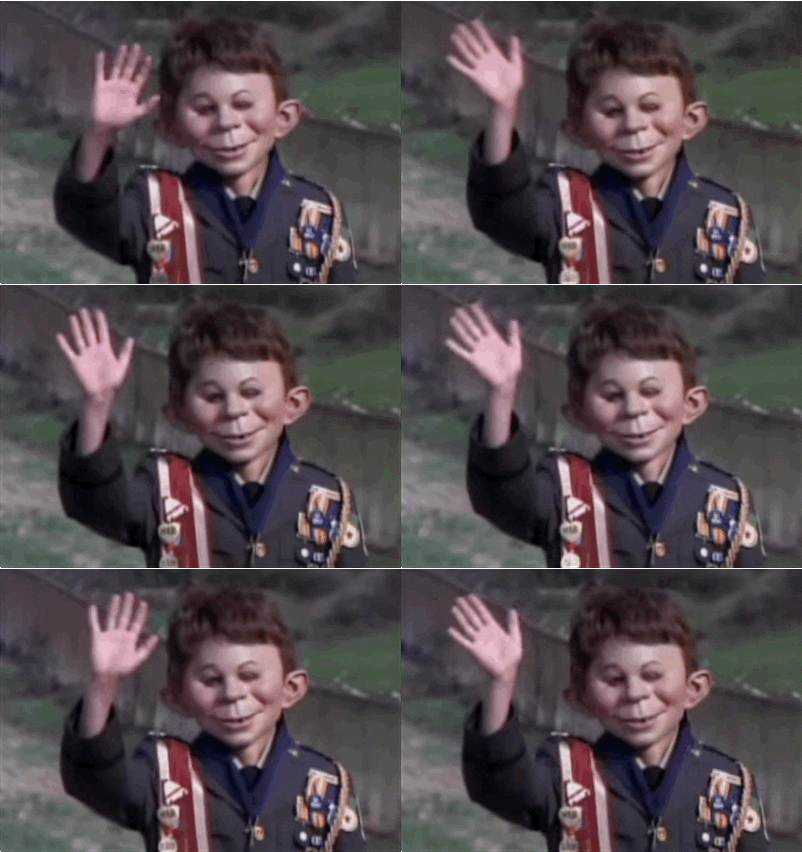
Before I dive into the most "What-me, worry?" sh*tfest out there, I need to say the magazine's mascot, Alfred E. Newman, does not make a memorable live-action character. In fact, live action Alfred is complete nightmare fuel. Obviously being affiliated with the magazine, Alfred's live-action appearance in the movie makes sense. But his appearance in the beginning and end of the movie is terrible and just flat-out weird looking, even for Alfred.
The plot of this teen comedy is a simple one that surely pulls influence from the movie Animal House released two years earlier.
A group of misfit teens from various walks of life are sent to Sheldon R. Weinberg Military School where they're under the watchful disciplinary eye of Maj. Vaughn Liceman (Ron Leibman).
Liceman, never unaware of what the students are doing or plotting, wants orders obeyed at all times while reassuring them he's really their friend.
Hating the rules, the students waste no time searching for girls, fun, fun with girls, girls looking for fun, having fun with girls, and having a fun party with girls but without the faculty's knowledge.
One student, Oliver (Hutch Parker), learns his girlfriend, Candy (not the kind found in the vending machines) is attending a girl's military academy nearby and manages to sneak over for a late night roll. Somehow, as the audience learns, Liceman spied on them and snapped a few Polaroids as evidence.
Oliver's father happens to be a politician running for a political office. So, Liceman's intention is to use the pictures against Oliver and his dad unless Oliver can hook him up with Candy. It's a weak plot that seems to be written as the movie goes along.
Oliver and the other boys form a plan to lure Liceman into their trap. 
During a dance, Candy (who's in on the trap) gets Liceman to meet her in secret under the impression that the two will...you know...hook up before she has to head back to her academy.
She gets Liceman into this scandalous situation as the other students surreptitiously take pictures of him.
Of course, he wants those pictures just as they want his pictures of Oliver. 
They finally agree to settle things with a soccer game: winner gets the photos. How soccer became an integral part of the plot is beyond me. Like I said, the movie writes itself as it continues on.
Not only is this movie completely terrible, it seems everyone involved in its production knew just how bad it was. That includes the publishers of MAD.
The humor doesn't rise above what the producers believed teens in 1980 would find funny - drugs, sex, and old people farting. 
There are a few off-color ethnic stereotype quips mixed in. At other times, the humor is dry, forced, and as predictable as a blind barber giving bad haircuts. There's also a turd floating in a punch bowl - literally.
To be fair, I did laugh at a few random moments. I think that was accidental, though. Still, even writers at MAD Magazine can come up with better jokes and satire than what the movie threw up on audiences.
And the plot, as simple as it is, is just everywhere. I'm talking hot dripping storyline splattered all over the walls and in the upholstery !
The entire movie reminds me of a high school play, written by dorky acne-ridden, gum chewing, soda chugging, MAD reading, immature high school students. The absurdity runs all the way down to the dialogue, delivery, and acting.
And the racial stereotype humor is just plain awful, and that's not even because they're stereotypes.
From what I've been told, some actors attempted to get their name pulled from the credits including actor Rob Liebman. He even threatened to sue to take his name off the credits. God bless them for trying to redeem themselves after they cinematic demonry they took part in.
To the movie's credit, the soundtrack is memorable, but only because it includes songs by legendary performers such as Blondie, Pat Benatar, and Sammy Hagar.
Unlike the magazine, this movie doesn't parody anything really aside from life at a Military Academy. It could have taken a much larger jab at school life, or the military. Instead, it chose to create a bunch of typical teenage shenanigans with very little creativity to try and make it memorable and hilarious.
MAD's publisher at the time, William Gaines, sent out apology letters to anyone who wrote in to piss and moan about the movie. He wanted the magazine to continue maintaining what little integrity it had.
In true MAD fashion, they came up with a parody of their own movie. In MAD #218, the writers presented, "Throw Up the Academy."
The spoof was cut short as it covered only two pages instead of the typical four pages movie satires general take up since the writers thought the movie was so bad, it didn't deserve an entire spoof. The writers also published a note that jokingly claimed the entire staff quit as the movie was that bad.
Thousands upon thousands of people lost out on $3  - the average price of a movie ticket in 1980. But like so much other tasteless crap, Up the Academy has somehow developed a cult following.
For reasons I can't imagine, this movie still has a spark of likeability. Maybe it's the nostalgia? Maybe it's the name MAD? Maybe it's drugs? Who knows?
As the words sprawled across MAD issue #218 read, "You could do worse...and you always have!"


While I'm on the topics: A young Robert Downey, Jr. was an extra during the soccer game scene. If you're bored enough to try and look hard, you might see him. You don't win any prizes if you catch him though. Here's a cheat video for anyone bored, but short on time.

Masters of the Universe (2026)

" Hang on, it's about to get weird. " Director Travis Knight Cast Nicholas Galitzine - Adam Glenn / He-Man Jared Leto - Skelet...