Tuesday, February 14, 2023

Parenthood (1989)


Director
Ron Howard

Cast
Steve Martin - Gil Buckman
Mary Steenburgen - Karen Buckman
Jason Robards - Frank Buckman 
Diane West - Helen Buckman
Martha Plimpton - Julie Buckman-Higgins
Joaquin Phoenix - Garry Buckman-Lampkin
Keanu Reeves - Tod Higgins
Rick Moranis - Nathan Huffner
Harley Jane Kozak - Susan Huffner
Tom Hulce - Larry Buckman
Jasen Fisher - Kevin Buckman


It's been about 30 years since I've seen the 1989 comedy "Parenthood" directed by Ron Howard. My family and I were visiting some friends in Southern California at the time. For a movie night, the grownups that be put this on. 
I wasn't even a teenager at the time, so my interest in watching "Parenthood" was non-existent. All I remembered from the movie was the ending. 
My wife and I decided to watch it the other night as we saw it was streaming on Netflix. As it was her time seeing it, I can honestly say it was my first time, too. 
It's a movie that has made quite an impact on pop culture. And there has been a lot said about it. 
It led to a short-lived television series in 1990 along with another, more successful, television series adaptation from 2010 to 2015.
The film surrounds the Buckman family, starting with Gil Buckman (Steve Martin) who is struggling in his attempts to balance family life and work life. Gil works as a sales executive in St. Louis. 
He and his wife, Karen (Mary Steenburgen) find out their oldest son, Kevin (Jasen Fisher), is having emotional issues at school. The school's counselor advises them to seek a therapist for Kevin. 
Distraught at this news, Gil starts questioning his capabilities as a father. He tries hard to understand what his son is going through and help him accordingly.
Karen later learns that they're going to have their fourth child.  
With financial troubles, and career issues, Gil is deeply concerned as to whether they can handle another child or not. 
Gil confides in his father, Frank (Jason Robards) if he's even capable of being a dad despite that he's already raising three children. Frank simply tells him that he worries too much, but that worry for one's kids doesn't end after childhood. It carries on into adulthood. 
Meanwhile, Gil's older sister, Helen (Dianne West), is a single mom as her dentist husband left her and their kids - Julie (Martha Plimpton), who's still in high school, and her youngest, Garry (Joaquin Phoenix). 
Julie is involved with a doofus boyfriend, Tod Higgins (Keanu Reeves) who doesn't embrace responsibility very well. Helen only wishes Tod would disappear from Julie's life as she, too, is rather troubled and takes no interest in her high school education. This leads to a lot of mother/ daughter quarreling. Helen finds out that Julie and Tod married behind her back, and that Julie is pregnant. She and Tod end up living at Helen's house.
Garry, meanwhile, is cold towards his mom. He finally opens up to her that he wants to live with his father. While Helen doesn't think it's a good idea, she still lets him try. 
He calls his dad to ask if he can live with him, but his dad doesn't allow it, which breaks Garry. In retaliation, he trashes his father's dental office and is later caught with pornographic video tapes. 
Helen quickly notices a turnaround for the better in her son after Tod becomes a positive male influence in his life as Garry can confide in. And Tod also starts to take on responsibility, especially as he's about to become a father at a young age. 
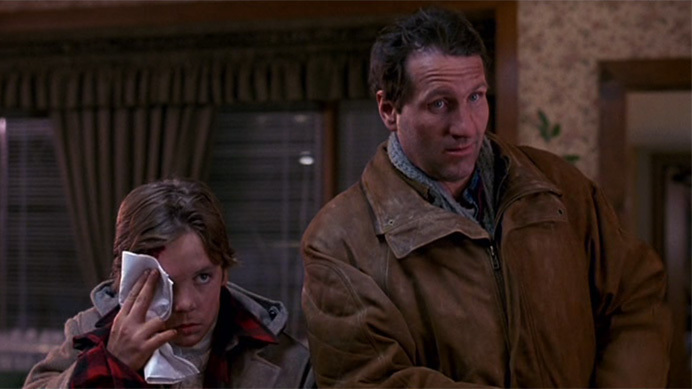
Jasen Fisher and Steve Martin in "Parenthood" (1989).
Elsewhere in this family, Gil's younger brother, Larry (Tom Hulce), is both a pariah in the family, as well as Frank's favorite son. 
Larry refuses to enter a career. Instead, he falls for various easy money schemes. 
As the Buckman's hold a family get-together at the beginning of the film, Larry shows up with a young bi-racial son named "Cool" (Alex Burrall). It turns out this child is the product of a short-lived love affair Larry had with a Las Vegas showgirl. This showgirl left Cool with Larry as he claims she shot someone and fled the country.
And in typical deadbeat fashion, Larry asks his dad for money. 
What Larry doesn't tell his dad, until it's too late, is that he owes gambling debts in the amount of $26,000. If he doesn't pay up, Larry says "they" are going to kill him. 
Frank is truly disappointed, especially after Larry secretly tries to sell his dad's prized vintage car. 
Sorely disappointed, Frank still decides to help him by tapping into his retirement funds which he'll now have to delay. 
However, he gives Larry an ultimatum. He'll only help him if Larry learns the family business so he can later take it over.
While Larry initially agrees, he suggests another idea that involves a quick money scheme down in Chile. 
Despite his better judgement, Frank agrees to it, as well as looking after Cool even though he knows Larry won't be returning.
Gil's younger sister, Susan (Harley Jane Kozak) who works as a middle school teacher, is married to researcher scientist Nathan Huffner (Rick Moranis). They have one child together, Patty (Ivyann Schwann) whom Nathan has pushed to be the advanced child that she is. 
Susan wants more children, but Nathan is more interested in Patty's continuous advanced learning. 
In retaliation, Susan starts eating more junk food and sabotages her diaphragm in the hopes of getting pregnant. 
But Nathan doesn't want to have another child. He's persistent about it. So, Susan leaves him. Crestfallen Nathan later walks in on one of her classes and serenade her hoping she'll come back. And she does. 
Frank's own mother, "Grandma" (Helen Shaw) plays the wise sage who really observes and says very little. And when she does say something, it's simple wisdom for her family to take what they can from it. The family, though, takes her as "grandma" who's just old. 
In one scene when Gil is complaining about how his life is too complicated, grandma randomly says, 
"You know, when I was nineteen, Grandpa took me on a roller coaster."
Gil thinks she's just lost in her old mind.
"Up, down, up, down. Oh, what a ride," she says.
"Great story," Gil says sarcastically.
"I always wanted to go again. You know, it was just so interesting to me that a ride could make me so frightened, so scared, so sick, so excited, and so thrilled all together! Some didn't like it. They went on the merry-go-round. That just goes around. Nothing. I like the roller coaster. You get more out of it."
Frank's relationship with his mother can be summed up in one line. When the family gets together in the first act, and grandma arrives, Frank snidely comments "Yeah, she's still alive." 
It's not any revelation to say "Parenthood" is a relatable film. It cleverly covers the job of being a parent from childhood through the teenage years and into adulthood. Afterall, a parent is a parent forever, tied in with Frank's statement that the worry of a parent over their children never goes away. 
There are good things I like about this movie. And there are things I don't like. That pretty much sums up my thoughts.
Thankfully, children aren't portrayed as completely chaotic. A house with children doesn't need to be chaotic during all waking hours, and into the night. In films, that's such a tired cliche.
I can certainly get behind the good decisions made by some of the characters despite the terrible ones that precede them. 
I appreciate the portrayal of Tod embracing the responsibility of fatherhood though the circumstances leading up to that were less than admirable. Things happen. We all make dumb decisions, some more stupid than others. What's important is how we handle the aftermath of our poor choices.
On top of that, the need for a strong male role model as seen in Garry's troubled youth is also, generally speaking, sensible and true despite that both he and Tod still have maturing to do. They have to start somewhere.
Jason Robards and Tom Hulce.
And above all, I truly appreciate the depiction of children still being a welcomed part of life despite the difficulties and stresses in day-to-day life they may bring about. 
Karen mentions the reprehensible notion of aborting their fourth child since their life is difficult at the moment. 
Thankfully, they both agree not to abort their unborn child simply because they're facing the same kind of difficulties millions of other people have to deal with each day. Difficulties come and go. Solutions are accessible. No innocent unborn person needs to die because life is hard sometimes. Both agree they'll be happier having another child. 
One thing I couldn't wrap my head around was Frank's decision to let Larry go and leave his son behind so easily. He doesn't put up any protest at his son, whom he deems his favorite, to make such a terrible decision. Sure, Larry is an adult and can make his own decisions whether good or bad. And Larry can't force him to stay. After he reluctantly agrees that Larry go to Chile, his grandson Cool, who looks to be about five or six years old, approaches Frank and asks, "Is he ever coming back?"
"No," Frank says.
Cool looks dejected and sad at this answer. 
"Would you like to live here, with us?" 
"Yeah," Cool responds.
"Good." 
Aside from the comedy, and the stellar cast, the story's relatability is certainly one this movie's strongest elements. 
That relatability can only sprout from honesty and truth. And the way each story within the Buckman family is balanced is impressive. Each is treated in its own time. Nothing seems overdone. 
We're given enough time with each member which allows the audience to grow invested in their troubles, thoughts, personal victories, and bad decisions. 
No matter how maddening or difficult children can be, they're value and influence on their parents, who grow alongside their children (intellectually) even amidst the good times and the bad decisions. 
The positive memories stay with parents. 
Worry for children never ends. Still, we as parents want them in our lives more than anything else. Almost every type of parent is within the Buckman family, represented through four generations. There's the self-questioning parent. The no good, lousy, greedy parent. The single parent struggling to keep it all together. The over-achieving parents. The doting parent. And the parent who has lived their life and are approaching the end. 
All the details are keenly observed while not overplayed. Each story throughout the family is well crafted and tied together truly organically. The resolutions are the important parts. Nothing is far-fetched or over dramatized.  
Kids are hard to raise. They consume their parents time and energy. Sometimes, they're the most frustrating people to deal with. Regardless, they're the reason good parents exist. To think of life without these people is a painful thought. They help parents grow in selflessness. No one can make a someone a better person like a child can. No one! 
Everything and everyone blend in well, no matter the flaws - especially because of the flaws. The comedy is genuine, and the storyline is truly sensible and accurate. 

Thursday, February 2, 2023

The Apartment (1960)

Director
Billy Wilder

Cast
Jack Lemmon - C.C. 'Bud' Baxter
Shirley MacLaine - Fran Kubelik
Fred MacMurray - Jeff Sheldrake
Jack Kruschen - Dr. David Dreyfuss
Naomi Stevens - Mrs. Mildred Dreyfuss
Ray Walston - Joe Dobisch
David Lewis - Al Kirkeby
David White - Mr. Eichelberger
Edie Adams - Miss Olsen
Willard Waterman - Mr. Vanderhoff

(Spoilers ahead)


I've wanted to watch director Billy Wilder's comedy "The Apartment" (1960) for a long time. I've checked it out from my local public library three times only to "never got around to it" the first two times. I forced myself the third time to put it on despite my mood to watch something else. 
When it comes to movies, desires and moods can conflict. Maybe they should call that "watching 'The Apartment' syndrome." That's what I'll call it, anyhow. 
The movie being a Billy Wilder film, as well as its classic line-up of actors (Jack Lemmon, Shirley MacLaine, and Fred MacMurray) are what pulled me in.
When it comes to Jack Lemmon, he's simply a favorite comedian of mine. I'll watch anything with Lemmon in it, and I have. Of course, when he's paired with Walter Matthau, it's even better.
Lemmon also mixes well with Billy Wilder. He's directed Lemmon's most notable films - "Some Like It Hot" (1959), "Irma La Douce" (1963), and "Avanti!" (1972). He also directed Lemmon and Matthau in their first film together, "The Fortune Cookie" (1966) along with "The Front Page" (1974), which is a favorite comedy of mine, and "Buddy, Buddy" (1981) - Wilder's last movie. I've previously reviewed the latter. 
Anyways, in "The Apartment," Lemmon stars as C.C. "Bud" Baxter, an office wage earner at an insurance company in New York City. 
Baxter, who's single and lives alone, moves up the ladder in his little corner of the corporate world by lending his Upper West Side apartment at 51 W. 67th St. to his company managers and their mistresses, whomever they happen to be at the time, for some unsavory extramarital foolin' around. 
Baxter sacrifices his reputation as his neighbors and landlord think he's quite the playboy. They often see all these different women coming in and out of his apartment. To them, he's a shameful sort as they have no idea what he's really doing. Of course, if they did, that wouldn't improve their impression of him.
Still, he makes sure his apartment availability schedule doesn't conflict among his four supervisors. As long as he plays ball, they each give Baxter raving performance reviews to personnel director, Jeff Sheldrake (Fred MacMurray). 
Once Sheldrake takes notice of Baxter, and promises him a grand promotion, he also requests the use of his apartment that very night to have an affair. This will seal the promotional deal. He even goes so far as to request Baxter's spare key so he can access the apartment at will.
To compensate for the short notice, he gives Baxter two theater tickets for that same night.
Baxter, meanwhile, has a crush on the office building elevator operator, Fran Kubelik (Shirley MacLaine). So, he uses the opportunity to ask her out to the theater. 
She graciously accepts the invitation. Little does Baxter know that she's Sheldrake's mistress and is meeting him that night. Still, she agrees to meet Baxter after her (ahem) appointment. 
While Baxter is waiting for her at the theater, he doesn't realize Fran is back at his apartment with Sheldrake. Needless to say, she stands Baxter up at the theater.
Jack Lemmon and Shirley MacLaine in "The Apartment."
Later, during an office Christmas party, Sheldrake's secretary, Miss Olsen (Edie Adams) tells Fran that she's not the first nor even the second girl Sheldrake has fooled around with. She admits that he's even had a fling with her before. 
When Fran meets up with him again at Baxter's place, she confronts him about this information Miss Olsen let out of the bag. 
She wants to break up with Sheldrake who promises to divorce his wife in order to dissuade her from calling things off. 
Sheldrake throws out empty assurances that he loves her before heading back to his unsuspecting wife and children.
It's not long before Baxter realizes his boss is having an adulterous fling with his crush, Fran. Heartbroken and feeling defeated, he meets a random gal at a bar and takes her back to his place. 
When the two walk in, he finds Fran passed out on his bed as she overdosed on some sleeping pills she found in his medicine cabinet. 
He quickly gets his neighbor, Dr. David Dreyfuss (Jack Kruschen) to revive her. 
Of course, Dr. Dreyfuss thinks this is all Baxter's doing and though he does help, he scolds Baxter for what he believes is a morally depraved philandering lifestyle. 
Fran spends a couple days at Baxter's apartment, recovering from her suicide attempt. During this time, they develop a friendship (in a good way, I mean) as she opens up about her affair with Sheldrake and her overall failed pursuits at romance. 
While Baxter prepares a nice meal for her one night, one of his managers drops by unannounced to try and get the apartment for the night.
Baxter, however, persuades him and his gal pal to hit the road. 
Before he leaves, he sees Fran and recognizes her right away.
So, in retaliation he tells his colleagues about Fran being at the apartment with Baxter. Word of Fran's whereabouts gets to her brother-in-law, Karl (Johnny Seven). As he and his family have been looking for Fran, he drops by the apartment and scowls at Baxter as a less-than-savory character. In fact, he decks him pretty hard. 
Sheldrake, meanwhile, finds out Miss Olsen got to Fran regarding his affairs. So, he fires her. But Miss Olsen gets the final blow when she tips off Sheldrake's wife about his cheating. This leads to his wife kicking the two-timing bum out of the house. Being the selfish jackass that he is, Sheldrake sees this as an opportunity to get to Fran with less obstacles in his way.
Baxter tells Sheldrake about Fran's attempted suicide, but he doesn't really seem to go out of his way to assist. He expects Baxter to cover for him.
Baxter finally comes to the conclusion that his integrity, reputation, and personal interest as well as Fran's are much more important than the unsavory desires of the untrustworthy horn dog higher-ups at the insurance company. And he lets them know it, including Sheldrake. 
As far as Billy Wilder's comedies go, this is one with a more dramatic side. Wilder knows how to treat the mood and atmosphere of his comedies the right way. I admit, though, that I've seen a small handful of his movies. Even so, I still get that impression. 
The comedy here is in the situation rather than in the dialogue. If you watch his comedy "The Front Page" after watching "The Apartment," the difference in comedic style is very apparent. With "The Front Page," the comedy is in the situation along with the circumstances, characters, plot and dialogue. 
"The Apartment" is a perfect balance of comedy, sadness, and romance. I won't get preachy on the subject of adultery which is presented with a hint of avantgardism. It's not the typical setting for a love story for the time. I wouldn't say it glamorizes adulterous relationships based on the outcomes of everything that's going on. In other words, the audience doesn't need to be slapped in the face with the fact such activities are wrong. Rather, we let the story do its work, consequences and all. When we see Sheldrake secretly taking a call from Baxter in regard to Fran on Christmas morning while his sons and wife open their presents, the morality and gravity speaks for itself. The audience is given the respect to draw the right conclusion without being lectured. Wilder is a sensible director and knows his audience is just as sensible.
The drama isn't completely with Baxter initially having to deal with the setback of thinking about the girl he admires in the arms of his conceited, immoral boss. 
It also exists in how empty everyone is. All these business type characters tout love when they're really all a bunch of entitled assholes. What's really unfortunate at first about Baxter is that he's a pushover. Though he's not quite an ass like his bosses, he's still just as selfish as he's willing to let men destroy themselves and their families by giving them the space to do that in. The only difference is that Baxter has a more likeable personality. The movie gives the audience feelings of sympathy, disdain, and hope. 
Once Baxter gets his principles straight, then he starts to win at the end. He becomes respectable when he gives up his position at work for at least some amount of honor.
Like his other films, Wilder uses a lot of widescreen shots which gives the actors space and atmosphere to support their emotions - tension, frustration, tightness, love and tragedy. 
Lemmon makes a perfect everyman. He's unassuming but the audience is drawn to him. He's sympathetic but not a complete mouse.  
Most of the story takes place around Christmas, when pain stings more severely. It's the most wonderful time of the year, after all. This definitely plays more on the audience's emotions. 
Two Charlie Chaplin movies came to mind while I watched this - "The Gold Rush" (1925) as well as Chaplin's 1952 dramatic comedy "Limelight." 
In "The Gold Rush" Chaplin plays "the little fellow" who, in the final act, is stood up at a New Year's party by Georgia (Georgia Hale), the girl he falls in love with earlier in the movie. Instead, she spends New Years with the jerk who claims to love her but is really brutish and self-seeking. It plays out a bit similarly in "The Apartment."
And like the movie "Limelight," Baxter's care for Fran after she attempts suicide is similar to Chaplin's character, Calvero, taking care of Terry (Claire Bloom) in his apartment after her suicide attempt. Both films use this as a major plot point of the film. 
"The Apartment" is a sort of lost time, or lost weekend, type of romance. It has a bit of poignancy, comedy, and romance that overcomes selfishness. That's certainly due to Lemmon's brilliant ability to evoke such emotions, and Wilder's keen sensability.

Friday, January 6, 2023

Yesterday (2019)


Director
Danny Boyle

Cast
Himesh Patel - Jack Malik
Lily James - Ellie Appleton
Ed Sheeran - himself
Joel Fry - Rocky
Kate McKinnon - Debra Hammer
Justin Edwards - Leo
Ellise Chappell - Lucy

(Spoilers ahead🎸) 

When I first read Stephen King's 2011 novel "11/22/63" about a time traveler who stops the Kennedy assassination, and then finds out what would have happened (according to King) if Kennedy hadn't been killed, I came up with a little story in my head about a guy who manages to claim one of the biggest Hollywood franchises as his own. I won't go into the details here. I'll save them for whenever that story is published...or written. 
I think it takes a great amount of imagination on top of a little research to come with ideas of what could have happened if an historical event did or didn't happen. That "what if" scenario is often just as intriguing as a ghost story. What could have been! 
As a Beatles fan, I was sold by the premise of the 2019 movie "Yesterday" when I first saw the trailer. 
What if the Beatles existed, and then didn't? And what if only one person, who happens to be a musician, remembers them and their songs? What would that musician do with Beatles music that's suddenly free for the taking. The movie takes these questions one interesting step further. 
The story centers on Jack Malik (Himesh Patel), a singer and songwriter who plays to small crowds. 
He travels with his manager and childhood friend, Ellie Appleton (Lily James) from gig to gig. 
While Jack thinks his attempts at a musical career are going nowhere, Ellie encourages him to keep going and not give up. She recognizes his talent.
While riding home on his bike one evening, Jack is hit by a car knocking him out. At that same time, a power outage occurs around the world for 12-seconds. 
Jack wakes up in the hospital, bruised but still alive and in one piece save for a few missing teeth. 
When he recovers, Ellie and his other friends have a small party to celebrate his recovery. During the party, they give him a new guitar as a gift since his old one was damaged during the collision. 
They encourage to sing something with his new gift. So, he does. 
Jack starts singing "Yesterday" by the Beatles. Oddly, neither Ellie nor his friends know the song and think he wrote it. They're taken back by how beautiful the song is. Jack thinks they're having him on, pretending they don't know the Beatles. 
After going to Google, Jack can't find anything online about the Beatles. He checks his record collection, and can't find any of his Beatles records. 
Lily James and Himesh Patel in "Yesterday."
Shocked and confused, Jack comes to the obvious conclusion that the legendary band never existed and he's the only person who remembers them. 
He works hard trying to recall all the Beatles song lyrics he can and starts performing them for others. As no one recalls the group nor their songs, Jack claims he wrote the songs. 
After a gig where he sings nothing but Beatles songs, a local music producer named Gavin (Alexander Arnold) wants him to record an album. So, he and Ellie do that with music only Jack knows were written by the Beatles. 
He then has a televised performance which catches the attention of famed singer/ songwriter Ed Sheeren (played by himself). 
Ed invites Jack to open for him in Moscow, again passing off Beatle songs as his own. 
After the show, Ed challenges Jack to a friendly competition. They each have to write a song in ten-minutes. 
After ten-minutes, Jack sings "The Long and Winding Road" which stuns everyone present.
Ed admits defeat to Jack.
"You're definitely Mozart, mate. And I'm definitely Salieri," Ed says. 
Soon, Jack becomes world famous as the greatest singer/ songwriter alive. Ed's manager Debra Hammer (Kate McKinnon) takes the reins of his career.
Meanwhile, Ellie finally admits she has been in love with Jack since childhood. This leaves Jack torn. His fame is getting in his way. 
While recording another album, Jack can't recall the lyrics to "Eleanor Rigby." So, he travels to Liverpool, England, the birthplace of the Beatles, to visit the places that they sang about in hopes the trip will jumpstart his memory - Strawberry Fields, Penny Lane, etc. 
Ellie meets up with him in Liverpool, and they share a long-awaited kiss. Jack is clearly in love with Ellie. But Ellie doesn't just want to be a one-night stand and has reservations about joining him in his celebrity life. This saddens Jack, of course, as treating her like a one-night stand wasn't his intention.
After Jack performs a rooftop concert, similar to the Beatles 1969 concert on top of the roof of Apple Corp headquarters, to promote a new album, two strangers pay him a visit backstage. 
Fellow Beatles fans, Liz (from Liverpool) and Ed (from Russia), tell Jack they also remember the Beatles and know he didn't write his songs. 
But instead of exposing him, they thank him for bringing their music to the world and hand him a slip of paper with an address on it that will change his career path for the better. 
While the storyline is certainly full of holes thanks primarily to the premise of altered time, which is really something that can't be helped, "Yesterday" is a fun movie. 
The story doesn't collapse in on itself under with the weight of all the questions that arise with the "what if" scenario and the direction things would go. Instead, the story stays focused. Afterall, why let what-ifs get in the way of suspending reality. 
Instead, the story uses some of that as a joke. While the Rolling Stones still exist in this altered universe, (weird as they were formed in the shadow of the rising success of the Beatles) Coca~Cola, cigarettes, the band Oasis, and Harry Potter have disappeared along with the Beatles. 
The clever part of the story is that while Jack possesses a gold mine of decades-long song writing work solely in his memory, his versions of their songs aren't quit the same because, simply, they're not his. He doesn't completely know the back story behind each tune. This is subtly observed as people around him ask how he came up with these various songs, and he can't really answer. Or, if he does, he doesn't go into detail. He just gives an answer to move past the question. 
For instance, Ed Sheeren comments on the title of the song "Back in the U.S.S.R." which Jack sings during the show in Moscow. It's an odd title for a new song pertaining to Russia. But it made more sense back in 1968 when it was written. Jack can't come up with a reason for using the former U.S.S.R. in his song. 
In the midst of climbing to success while dealing with his relationship with Ellie, and the guilt of passing off songs that aren't his, he forgets the purposes of each song and the spirit of the Beatles. He simply wants to mimic their career, album by album, song by song. 
When he's visited by Liz and Leo, it then hits him that he has no part in all the Beatles songs outside of simply liking their music, remembering their impact on the world, and recalling the lyrics. Otherwise, the mind, heart, and soul of each song doesn't belong to Jack. The true reason for their existence isn't his to claim. That point is made clear without having to state it. Jack, Leo, and Liz find themselves the only stewards of music that suddenly no one has heard before. Jack is the only one of them that can sing. Outside of that, none of it means much to the record company and the other powers that be standing over his career.
The company that wants to launch his album doesn't care much for the album names Jack recommends which are titles of Beatle albums. Ed Sheeren later suggests the song title "Hey Jude" is too old fashioned, so recommends the title "Hey Dude." 
The film ends with Jack dropping in on John Lennon whose still alive and living a quiet life as he hadn't risen to fame since the Beatles never were. He tells Jack to pursue his true love, and above all, live an honest life. 
I'm not too familiar with director Danny Boyle's other films, which includes "Trainspotting," "28 Days Later" and "Slumdog Millionaire." But he manages to make something entertaining and unique with this movie.
I have mixed feelings about Kate McKinnon's performance. While McKinnon is a comedian, and a good one for the most part, her performance seems awkward to me. She's great at playing a money-driven materialistic manager calling the shots. It's too similar to pretty much every other role I've seen her play. At the same time, her character is supposed to be unlikeable, and she portrays that well. 
The montage scene is a bit different from the formulaic ones seen over and over again. This time, Jack watches his success climb as it's played on a giant screen. 
While time travel or time altered stories have been turned to movies before, "Yesterday" is a fun fantasy film that explores a unique "what-if" scenario. It stands out among other such movies. 
It ends on a very bold move that raised eyebrows among audiences. I think it definitely fits such the story and was the only logical place to go.

Saturday, December 31, 2022

The Triplets of Belleville - Les Triplettes de Belleville (2003)

"What have you got to say to Grandma?"

Director
Sylvain Chomet

Cast
Graziellia de Villa - Madam Souza
Noël Baye - Champion


There's no other way for me to start this post other than stating right away that this is one of the best animated movies I have ever seen. Among those "seen" movies I'm referring to, I'm thinking along the lines of some of Disney's early films that were clearly made for the sake of showing off the company's animation skills - "Fantasia" (1940), "Make Mine Music" (1946), "Melody Time" (1948), and "Sleeping Beauty" (1959). Those are impressively animated movies which, to me, stand above the rest of Disney movies as far as animation goes. 
I'm also referring to another impressively animated film, "Akira" (1988), from Japan. In my mind, "Akira" certainly sets a high animation standard. 
As I've mentioned before, back in my single and living alone days I used to pull random movies off the shelf at my local library so I could call myself cultured. I'd look for movies I was completely unfamiliar with. The French animated film "Les Triplettes de Belleville" was one such movie. I watched the U.S. version "The Triplets of Belleville" which I'm fairly certain is the same as the French version, but in English. Regardless, I was instantly enthralled with its story, atmosphere, style, animation, music, humor, and imagery.
You know, there have been a few instances (maybe more?) when I've watched a movie, and after a while completely forgot I ever watched it. Normally, my wife is the one who reminds me I've seen a forgotten movie before. If I happen to watch something my wife and I have seen before, something will click in the back of my mind prompting me to ask, "have we seen this before?" The answer is normally "yes." But the when, why, and where is forever lost in my memory even after my wife recalls those details.
In some cases, I'll faint recollections of actors or scenes will remain in the back of my mind like ghosts in a haunted house but everything else is gone. 
Such is the case with Elijah Wood's 2005 movie, "Everything is Illuminated." 
I remember watching it. I remember Wood's role, and some of the scenes. Yet, I had to look up Wood's filmography because I couldn't remember the storyline nor the title. 
Thankfully, "The Triplets of Belleville," a film by French animator and director, Sylvain Chomet, has remained completely unforgotten since I first found it at the library over 10 years ago. 
The film opens with the singing trio, Rose, Violette, and Blanche, in the height of their musical career. The animation in the opening scene is stylized like a Max Fleischer cartoon of the 1930s. Characters have rubbery contortions, wavy thin arms and wide-open eyes, (i.e. Betty Boop or Popeye). Overweight wives drag along their small, subjected, skinny husbands behind them. 
A Vaudeville-esque show opens with musical performances from the likes of Fred Astaire and Josephine Baker. Each one ends terribly.
The story shifts to somewhere in France where Madame Souza is raising her grandson, Champion. They're watching this opening segment as it airs on an old variety show on television.
Souza asks the young Champ "is it over?" Clearly bored and, perhaps, a bit depressed, he doesn't reply. Instead, he watches the next segment - a piano concert of Glenn Gould playing Bach.
The opening of "The Triplets of Belleville," animated in
the style of early cartoonist Max Fleischer.
Of course, Souza takes notice of Champ's potential interest in the piano music. She drags out an old piano and tries to raise his spirits and his interest by playing scales. Champ doesn't take the bait. 
Souza realizes that her grandson is suffering from loneliness. So, she gets him a dog named Bruno.
Though he does appreciate the dog, neither Bruno nor anything else his grandmother gives him to raise him up from the doldrums of loneliness seems to work. 
While making his bed one afternoon, she looks at all the pictures of bicycles and bicyclists he has taped to his bedroom wall. She also finds his scrapbook filled with cutouts of bicyclists and bicycles.
So, Souza gets him a tricycle. Champ is thrilled!
He now has a means to pursue his passion of bicycling.  
The story shifts to Champ as an adult. Souza helps her grandson train for the Tour de France.
She even fixes his bike wheel and bent spokes. 
During the Tour de France, Champ and a couple other bicyclists are kidnapped by mafia henchmen 
who take them across the ocean to the U.S. 
Realizing what has happened, Souza pursues them by renting a paddleboat and chasing the ship across the ocean. 
Once she's in America, in the City of Bellville, she has no money and no place to stay. But she's determined regardless to find her grandson.
While camping out under a bridge one night, trying to occupy her mind by making a small tune on Champ's bicycle wheel, the famous Triplets just so happen to stumble upon her small encampment and take her to their apartment for food and warmth. 
Impressed by her musical talent, they include her into their musical show. 
During a performance at a swanky night club, Souza recognizes the mobsters who kidnapped Champ.
With the help of the Triplets, she is able to follow them to Champ's location where he and other bicyclists are forced to bike in a simulated race for gambling purposes. 
Souza and the Triplets square up against an entire underground of thugs to rescue Champ.
"The Triplets of Belleville" accomplishes a lot with very little spoken word. 
The only speech in the movie comes through electronic means - the television, a record, a radio. Or, when Madame Souza speaks to her grandson while off screen. 
Charlie Chaplin did something similar with his movie, "Modern Times" (1936). Save for Chaplin's gibberish pantomime song in that film, the majority of speech comes through artificial means - a screen intercom, a radio, or an audio recording. 
An old rule of storytelling is to show rather than tell. This film follows the rule superbly leaving so much room for the pantomime to speak for itself. And what's more impressive is that the characters are likeable without having to talk.
The triplets themselves are certainly an odd trio, finding the means in ordinary objects to make music - a old refrigerator, a vacuum cleaner, and a newspaper. Each item is treated with respect. 
The city of Belleville is just as much a caricature as the characters themselves. It's a mix of New York City, Paris, Montral and Quebec City according to a 2003 article in the SF Gate. 
The rampant self-indulgence of the city is portrayed through the obesity of just about everyone in town. Even their "Statue of Liberty" is robust and portly. 
On top of that, the image of wine bottles is incorporated in most of the city's architecture. 
There's a running quip among some of the side characters taking on animal characteristics. A short maintenance guy whom Souza follows to the mafia thugs has protruding buck teeth and makes a squeaking noise when he breaths.
Some of the bicyclists have longer faces like a horse and make horse sounds when out of breath. 
One subtle jab shows a logo with a smiling cow's face that looks like a woman. 
And the diet of the sisters is frogs prepared in various forms, even as dessert. 
The sound and musical scores, particularly the use of Mozart's Mass in C Minor, are absolutely amazing and truly effective in establishing the atmosphere Chomet is animating. 
His animation is masterful as it steals the show. To me, the style is like Al Hirschfeld caricatures heavily mixed with French street art. The detail is entrancing. I could stare at these images for hours. The subtle innocent pokes at society, down to the characters eye movements, as well as the depiction of light and shadow is what makes the animation stand out among other animated movies. 
A lot of scenes possess so much that it takes several rewatches to see it all. This, mixed with the panning to show off each nuance and detail, is entrancing. 
Chomet's work is certainly not obscure. The film simply deserves more attention. 
He once animated a couch gag for the sitcom "The Simpsons" in 2014. The show even parodied "The Triplets of Belleville" in the episode "Angry Dad: The Movie" (season 22, episode 14). 
This is a fresh movie unlike any other animated film I've seen. The story is drips with originality. The care and devotion of Chomet, who was inspired by his own youth, is ever present in the work. 
The same is true for the film's pacing. Initially, I thought this would drag out. How wrong I was. 
At a run time of one hour and 21 minutes, the film accomplishes its goal without overstaying its welcome. The film's title song "Belleville Rendez-Vous" sung by French rock singer, Matthieu Chedid, known professionally as "M," left me with an ear worm. It's catchy! 
Chomet's film is a jewel of a film in the world of animation. It certainly sets an animation standard.

Friday, December 16, 2022

Funny Farm (1988)


Director
George Roy Hill

Cast
Chevy Chase - Andy Farmer
Madolyn Smith - Elizabeth Farmer
Kevin O'Morrison - Sheriff Ledbetter
Alice Drummond - Ethel Dinges
Bill Fagerbakke - Lon Criterion
Nicholas Wyman - Dirk Criterion
Glenn Plummer - Mickey
Joseph Maher - Michael Sinclair


The movie "Funny Farm" is an eighties comedy that doesn't seem to be as nostalgically remembered as other comedies from the same decade.
That's a bit strange as the movie is one of comedian Chevy Chase's best. However, that's kind of understandable as it had some heavy competition upon its release back in June of 1988. 
"Friday the 13th VII: The New Blood," "Crocodile Dundee II," "Willow" and "Rambo III" came out in theaters the month before, just in time for summer. 
"Who Framed Roger Rabbit?" "Coming to America" and "Big" came out in June. And then "Die Hard" was released the following month. Stiff summer competition, indeed, leaving "Funny Farm" with all the qualifications to be a "cult classic."
I knew about "Funny Farm" for a long time. I remember seeing copies of it at my local video rental store back in the early 1990s. However, I've never seen it until now. Even so, I've been curious why it's not talked about like other comedies of the 1980s.
Chase plays sportswriter, Andy Farmer, who's leaving New York City and the paper business to move into the nice, quiet rural town of Redbud, Vermont with his wife, Elizabeth (Madolyn Smith).
He plans to embrace the small quiet atmosphere so he can focus on writing a novel. 
As soon as they move into their new country home, all the less-than-charming peculiarities of rural community life intrude on their expectations just as soon as they breath in the open country air. The local mailman is drunk by the time he reaches their home. They can't even enjoy the fresh air itself as there's buzzing, stinging bugs sharing that the same air. It only takes one annoying and intrusive hornet to destroy one's tranquility. 
Andy's publisher paid him in advance to write a novel, which he gets to work on right away once they're all moved in. 
Little does he know that Elizabeth, inspired by the open space, is also writing a story though she's not a writer. 
Andy manages to finish the first chapter and presents the manuscript to Elizabeth as a gift while they're on a romantic getaway at a nearby cabin. 
After reading it, her reaction is less than favorable. In fact, her thoughts are completely critical. It even brings her to tears. This critique pushes Andy into a despair which hurts their marriage. 
Later, his publisher drops in to see his manuscript after letters from the publishers informing Andy about his deadline go unanswered. 
Desperate not to lose his advance payment, Andy gives the publisher Elizabeth's manuscript, claiming it's his own.
Elizabeth gets a call days later from the publisher who loves the "children's book." Realizing what Andy had done, Elizabeth packs up and leaves the moping Andy, and wants a divorce. 

Chevy Chase and Madolyn Smith in "Funny Farm."

So, the dream of a quiet country life - a nice place to write a book - is now down the toilet for Andy. 
He and Elizabeth decide to sell the house. To make the process speedy and give potential homebuyers a good impression on the community, they ask Redbud residents during a town meeting to help by turning the entire town into a Norman Rockwell-esque community just in time for Christmas. Elizabeth even passes out old copies of the "Saturday Evening Post" with Rockwell images on the covers to give townspeople ideas on how to pull this off. 
In return, the Farmers offer to donate $15,000 to the entire town, plus $50 to each resident who helps. 
So, the town agrees. And when another couple take interest in their home, the whole town puts on the facade of a quiet, comfy hometown that only Norman Rockwell could love. And they really put themselves into the sham, even the drunk mailman. 
Lest I forget, as a "Ghostbusters" fanboy, I need to mention Elmer Bernstein composed the musical score for "Funny Farm." Bernstein also composed the score for "Ghostbusters." 
Also, actress Alice Drummond, who plays the librarian at the beginning of "Ghostbusters," plays Redbud's antique dealer, Ethel Dinges.
The "Funny Farm" plot seems like a mix of the 1975 Neil Simon movie "The Prisoner of Second Avenue" with Jack Lemmon and Anne Bancroft, with a slight tinge of the 1986 Tom Hanks and Shelley Long comedy "The Money Pit."
Like "The Prisoner of Second Avenue," this film sees the roles of the protagonists switched thanks to unwanted circumstances that fall in their lap. 
Andy Farmer is the writer who is unable to write a good book while his non-writing wife happens to write a children's novel that quickly gains the approval of Andy's publisher. All the while, the small hometown atmosphere is more problematic than they thought it would. It's similar to Jack Lemmon's character, Mel Edison, losing his job and having to perform house duties while his wife Edna (Anne Bancroft) ends up being the bread winner as she quickly finds gainful employment. Like Mel, Andy is left with his wandering thoughts and obsessions with his less-than-perfect environment. And living in New York City ends up driving him crazy. 
While the Farmers' new home in "Funny Farm" is a beautiful house that's certainly no money pit, it's similar to the film "The Money Pit" in that the couple are met with bizarre house-related obstacles such as finding a casket with human remains buried in the garden. But this scenario of let-downs and burdens extends outside of the house into their new community.
Once they have the casket exhumed and taken to the local cemetery for a proper burial, the Farmers are met with a huge funeral bill they refuse to pay. It leads to the body being put back in their garden. 
In another scene, Andy goes to fish in the pond near the house. However, he ends up catching a live snake that makes its way into the house. 
I love how the film utilizes imagery similar to Normal Rockwell's "Saturday Evening Post" covers. The only other movie I know of that does that is "The Sting" with Robert Redford and Paul Newman.
"Funny Farm" makes a joke out of such small-town charm like that depicted in Rockwell's paintings. As the small town of Redbud ends up lacking such charm, the Farmers pay the residents to at least make it look like it possesses it. 
They even hand out old copies of the "Saturday Evening Post" as visual aids. 
The flow of the story is impressively well paced. The situation comes about naturally as all the plot points fall into place rather than being pushed. Neither the story nor humor feel forced or awkward. 
The comedy is a little more subtle than other comedies of the 1980s. Still, it's clear when it comes about. The story and humor work really well together. The plot lets the comedy work on its own.
Again, nothing feels forced. That's no surprise as director George Roy Hill has made some of the best films in movie history such as "Butch Cassidy and the Sundance Kid" (1969) and "The Sting" (1973) - the latter being one of my top favorite films. "Funny Farm" certainly couldn't have a better director. 
On a side not, I had a dream a few weeks ago in which I couldn't remember the title of "The Sting." When I awoke, I had to think about it. What was that movie with Robert Redford and Paul Newman in which they play con artists, and the theme is a Scott Joplin tune? Weird, right?  
Anyways, Chase is perfect in this role. He taps into that all-American character I recognize when he plays Clark Griswald in the National Lampoon Vacation movies. Here, he adds a hint of his insult comedy he's well known for. He plays his part like a duck on a frozen pond. 
If I want to nit-pick, a small bit of the comedy is a tad slapsticky but not far-fetched. I'm referring namely to a scene in which Andy goes fishing in a local competition with three other locals. When a fishhook gets caught in neck of one of the fishermen, the three other teammates fumble around like the Marx Brothers trying to hold him down and get the hook out. The injured man yells at them to stop. Farmer tries punching him in an attempt to knock him out, but it's not working. So, he punches him a few more times. Then he grabs an oar and accidentally slaps one of the other guys. It's just mishap after mishap. What's hilarious, however, is that the guy he tried to punch as a rescue attempt hates him throughout the rest of the movie, resorting to strangling and punching each time they cross paths. 
My other nitpick is the film title. While Chase and Smith play characters with the last name "Farmer," the title seems like a stretch. It doesn't quite fit the premise, namely because the story doesn't take place on a farm. Farming has nothing to do with the plot. I understand the premise of going crazy, but the title makes the movie seem like it's sillier and cornier than it is. "Funny Farm" sounds more like an early working title that just didn't get change by the time of the film's release. But, again, that's easy to look over.   
"Funny Farm" is an odd-man-out comedy, and one of the best of such comedies I've seen. It's impressive how well the entire story comes together, and how naturally one thing leads to another. The final act with the Farmers paying the community to make Redbud the kind of town they wanted in the first place rings of originality. 
The film proves to be a small wonder that deserves appreciation though it doesn't seem to be the nostalgic flick other films of the decade are. If the label "cult classic" is a term of endearment, "Funny Farm" truly deserves the compliment. 

Saturday, November 26, 2022

Dutch (1991)

"You might be the toughest little whacker at the junior high but in my world, you're about as worrisome as a cloudy day."

Director
Peter Faiman

Cast
Ed O'Neill - Dutch Dooley
Ethan Randall - Doyle Standish
JoBeth Williams - Natalie Standish
Christopher McDonald - Reed Standish
Ari Meyers - Brock
E.G. Daily - Hailey
L. Scott Caldwell - Homeless woman
 

When it comes to John Hughes's holiday comedy films, specifically his Thanksgiving comedy holiday films, "Planes, Trains, and Automobiles" is likely all that comes to mind for most audiences. Released in 1987, it's a holiday comedy road trip movie about two complete strangers, Del Griffith (John Candy) and Neal Page (Steve Martin), who end up trying to get from New York City to Chicago together in time for Thanksgiving. 
Earlier this week, a special edition of the film was released with an additional hour of extended or cut scenes - a special edition I've been hoping a long time would surface. 
Hughes' other Thanksgiving comedy road trip movie with two people who don't necessarily pair well doesn't seem to garner as much attention.  
"Dutch" was released in 1991 and stars Ed O'Neal and Ethan Randall. Written by Hughes, it uses a similar formula to "Planes, Trains, and Automobiles." That might partly account for its lack of acclaim. It also bombed upon its release, earning $4.6 million domestically after its $17 million budget. That also might account for its lack of popularity.
The film begins with a posh dinner party in which Natalie Standish (JoBeth Williams) finds herself unable to fit in. She's not as stuck up as other attendees. Her new boyfriend, Dutch Dooley (Ed O'Neill), who's also at the party, is certainly not one of these upper-class types. Dutch is a middle-class working man.
He's a bit coarse and doesn't dress in clothes as nice as theirs. 
During the party, Dutch has the "pleasure" of meeting Natalie's wealthy arrogant ex-husband, Reed (Christopher McDonald). 
Reed cancels his Thanksgiving Day plans with their son, Doyle (Ethan Randall) who's away at a private boarding school in Georgia, as he has to take a business trip to London. Or so he says.
Being the jerk he is, Reed has Natalie tell their son of his cancellation despite Doyle looking forward to seeing his dad. 
Unwilling to break the news to Doyle since Reed should be the one to do it, Natalie wants Doyle to come home to her house for Thanksgiving.
Doyle, however, blames his mother for his parents' divorce, and refuses to spend the holiday with her. Instead, he stays at school - alone.  
Dutch sees an opportunity to score some relationship points with Natalie. 
Ethan Randall and Ed O'Neill in "Dutch."
He offers to drive from Chicago to Georgia and pick up Dutch for Thanksgiving. 
When he finally arrives at the school unannounced, he finds Doyle is just as snobbish and self-centered as his dad. Their introduction is rather painful (literally) for Dutch. 
Still, he makes sure he keeps his promise, and drives her reluctant kid back to Chicago. 
As the pair take on the long road trip back to Natalie's, they're met with several obstacles along the way such as Doyle parking Dutch's car in the middle of the highway, leaving the pair forced to end up hitchhiking with two prostitutes who steal Dutch's wallet. 
Some of the comedy borders on slapstick, namely with Doyle beating up on Dutch starting as soon as the two meet. It continues all the way unto the end in a tit for tat style comedy. 
Unlike the same general premise in "Plains, Trains, and Automobiles," Doyle is at the mercy of Dutch, driving home with him against his will. It changes the comedy a bit since the motivations for the characters in both movies are different. 
In "Plains, Trains, and Automobiles," Del Griffith and Neal Page are only stuck with each other by random circumstances. Their only shared motivation is to get to Chicago. The comedy lies in these two completely different people with nothing in common stuck in each other's company all because their flight got cancelled. The audience wants to see how they'll interact in various circumstances.
With "Dutch," Doyle has no choice about going back home. He doesn't want to go because he blames his mother over his parents' divorce. At the same time, Dutch is trying to score points with his mother by driving round trip to pick him up. Doyle uses Dutch as a way to get back at his mom. Dutch uses Doyle as a means to garner love and appreciation from Doyle's mom.
During most of the trip, Doyle looks down on Dutch, berating him for his middle income and working-class social standing. Dutch, meanwhile, reacts by putting young Doyle in his place because he's the one with life experience and self-dependency. Doyle just has his jerk of a father's influence and money.
In one scene when the two are at a diner having breakfast, Doyle starts in on Dutch.
"I beat you mentally, then I beat you physically," Doyle says.
After a little bit of back and forth, Doyle says, "You're a clod. And the cool part is I can say that. And you can't do anything about it because I can kick your butt."
Dutch smirks, leans forward and stares right into his eyes.
"Well, I won't cop to that, but I will say this. There's one thing I can do that you can't," Dutch says.
"Oh yeah? What?"
"I can pay for my breakfast."
This gotcha comedy carries into the next scene after breakfast when Dutch and Doyle are outside the diner thinking about what to do next as Dutch lost his car the night before. 
Dutch says in passing, "Nothing burps better than bacon. Your water looked tasty."
The movie carries a light bit of charm to it, thanks to the familiar Hughes formula. In that standard formula of his, there's an experience out there for his characters to see for themselves and thus improve their faults or misconceptions. All they need to do, in some way or another, is step out of their element or mindset through some situation out of their control, and face reality. Or, they have to face life through someone else's eyes. It's a standard Hughes trope seen in a lot of his movies such as "The Breakfast Club," "Uncle Buck," and even "Home Alone." His characters are put in some undesirable situation (Saturday detention, a long road trip with some unsavory shlub, or being stuck at home while the family is off on their Christmas vacation) only to come out cleaner in the end. 
"Dutch" is already similar enough to "Plain, Trains, and Automobiles" in more ways than the Hughes formula. Both movies depict a car getting destroyed. The main characters have their wallet stolen. The final destination in both movies is Chicago. The main characters don't like each other. And they finally make it to their destination following setback after setback. 
Both Ed O'Neill and Ethan Randall really put forth as good a performance as they can muster.
O'Neill doesn't mushy up the role. He plays it genuine and straightforward.
He was in the middle of playing "Al Bundy" in the sitcom "Married...With Children," - a sitcom I don't care for - in 1991. His sitcom character was known for luck never being on his side, and yet he always has the final insult. His Dutch carries a bit of that same comedy style since luck certainly isn't on Dutch's side. Still, he manages to put Doyle in his place with his sharp wit.  
O'Neill has a likeable persona to him even in this movie. He has a knack for playing the all-American working-class man. Unfortunately, some of the round-a-bout decisions Dutch makes only serve to maintain Hughes' comedy. The circumstances aren't completely working enough against him to justify some of the out-of-the-way decisions Dutch makes which just lack common sense. He only makes such choices to keep the movie a comedy. Regardless, it doesn't always match. 
Despite his obnoxiousness, Doyle is a sympathetic character. He carries a lot of issues rooted in his parents' divorce, and his bitterness towards his mother. He lashes out as he's a product of a love that doesn't exist anymore. The movie some effort to explore Doyle. But his problem-child vengeful actions towards Doyle get in the way since the movie is, again, trying to get laughs out of the audience. It goes on for a little too long to the point where it feels forced, and I would have hardly cared less if Dutch tossed Doyle off a bridge, and then broke off his relationship with his girlfriend.
Speaking of "The Breakfast Club," I wonder if Doyle Standish is any relation to Molly Ringwald's character, Claire Standish. Afterall, they're both from wealthy families. 
Also, according to imdb.com, John Candy was considered for the role of Dutch. I'm sure he would have nailed the role. Yet, I think it would have made the movie even more similar to "Plains, Trains, and Automobiles." 
"Dutch" is not a completely terrible movie as it certainly tries to be a likeable, relatable comedy. There's chemistry between O'Neill and Randall. But the scenario and Hughes's formula grows weak and ridiculous despite its best efforts. It almost works, but lacks the push to get it where it should be.

Tuesday, August 30, 2022

Being There (1979)


Director
Hal Ashby

Cast
Peter Sellers - Chance the gardener/ Chauncy Gardiner
Melvyn Douglas - Ben Rand
Shirley MacLaine - Eve Rand
Richard Dysart - Dr. Robert Allenby
Jack Warden - the U.S. President
Ruth Attaway - Louise


Way back around 2010, I got into a habit of checking out random films and documentaries I was unfamiliar with from my local library. Back then, I was living alone. I was single. I was in college. I felt adventurous. But I was cheap. So, that's as far as my adventurous-ness would take me.
Checking out the obscurest (for me, at least) movies I could find became a long-lasting hobby of mine.
Some of those movies, such as "The Paper," I've already written about. Others, such as the French animated movie "The Triplets of Belleville" I'll eventually write about some day. 
Back then, I hadn't heard of the 1979 movie "Being There." Seeing that it stars Peter Sellers, one of my top five favorite comedians of all time, was the selling point for me. And yes, I do have a mental list of top five favorite comedians. 
But I wasn't as keen a movie viewer then as I believe I am now. So, I missed a few things here and there in the story. Still, I was intrigued by "Being There" ever since. 
A few years after first watching "Being There," I came across another movie I never heard of that aroused my intrigue. That movie was the 2004 made-for-TV biopic "The Life and Death of Peter Sellers" starring Geoffrey Rush. That's another movie I hope to review later. 
There's a part of the movie that depicts the period when Sellers' worked on this particular film.  
which is based on the 1970 novel of the same name by Jerzy Kosiński. Sellers was evidently eager to make "Being There." He tried for years to get this movie off the ground.
In my last post, I cited the movie "Brazil" as being a favorite satirical social commentary film of mine. "Being There" is a favorite satirical comedy of American political life. Not only is Sellers perfectly cast in the lead role, but the movie also has a stellar supporting cast which includes Shirley MacLaine, Melvyn Douglas (who died a few days before I was born), and Jack Warden.  


Peter Sellers and Melvyn Douglas had known each other
since the 1940s, according to Douglas's granddaughter, Illeana Douglas.
The Plot
"Chance" (Peter Sellers) works as a gardener for a wealthy man who seemingly lives alone, aside from Chance residing in his Washington, D.C. home as well. 
He has apparently lived with this rich old man since childhood, always taking care of the garden. Chance has also never left the house in his life. 
His window to the outside world has been television and only television. Everything Chance knows of the world is from watching T.V. 
The movie starts with Chance waking up on another typical morning. He turns on the television - there's one in every room - and goes through his regular routine. 
However, Louise, the old man's housekeeper, tells Chance that his benefactor has died. 
Chance is completely naïve about the gravity of the situation. He's now alone in the house, but continues doing what he has always done - tend the garden and watch T.V. 
Some attorneys stop by unaware that Chance is still living there. Surprised by his presence, they ask him if he has any Claims on the old man's estate.  
As he doesn't know how to respond, nor what the attorneys are talking about, he tells them, "I have no Claim. I don't even know what one looks like."
So, they inform Chance he must be moved out by noon the next day. 
He packs up a single suitcase, mostly with suites that belonged to the old man, stored in a trunk up in the attic, and aimlessly wanders around Washington, D.C. 
Chance doesn't know how to interact with other people. He approaches a random woman and asks if she would please make him a sandwich.
He also goes up to a street gang inquiring where he might be able to find a garden to tend to. 
That interaction doesn't go well. 
As he meanders around well into the evening, Chance walks past a T.V. store with a television and camera displayed in the store window. The camera captures passersby on the screen. Chance is enamored at seeing himself on T.V. He backs up and steps off the curb when a chauffeured car belonging to a wealthy businessman named Ben Rand (Melvyn Douglas) accidentally backs in and hits him on the leg. 
Ben's wife, Eve (Shirley MacLaine) is in the vehicle. Apologetic for the accident, she offers to take Chance to the hospital. 
On their way, however, she suggests instead to take him back to her estate where an on-site doctor caring for her elderly husband can examine his leg. 
Peter Sellers as "Chance."
She also offers him a stiff drink and asks what his name is. The alcohol doesn't go down well, and Chance starts coughing. 
He says "Chance, the gardener" while coughing, but she thinks he says "Chauncey Gardiner." So, that's how she introduces him to her husband.
Ben is pleased to meet him and thinks he's a well-off highly educated businessman like himself. The couple encourage him to stay in their huge estate until his leg is mended, which he does.
At supper, Ben mistakes Chance's explanation of the lawyers kicking him out of the old man's house as meaning his business was forced to close thanks to the attorneys.  
Ben happens to be a close friend and advisor to the President of the United States (Jack Warden). 
After a few days, the president is scheduled to pay Ben a visit. Ben wants Chance to be a part of his meeting with the president.
He introduces him as Chauncey Gardiner before he and the president start discussing the economy. 
When the president inquires how to "stimulate growth," Chance considers this a gardening reference. 
So, Chance chimes in with gardening advice and the changing of the seasons. 
The president hears this as deep seated and optimistic political advice. So much so that the president quotes Chance by name during his next televised speech.
Of course, the world's attention quickly turns to Chance. If he's influential enough for the U.S. President to mention him by name, inquiring minds want to know who Chauncey is, where he's from, and what other words of wisdom and philosophy he has to offer. 
Chance quickly finds himself interacting with various influential individuals such as a publisher, a Soviet Ambassador, members of the press, and wealthy businessmen who want to hear more of his deep and insightful financial knowledge. 
Yet, in the midst of all this notoriety, nobody from the press, nor the President's cabinet, nor 16 other countries can find any background information on Chance. This leads to all kinds of conjectures as to why that is. All the president's advisors can find is the make and model of his clothing, which he pulled from his caretaker's trunks in the attic. They were all tailored in the 1920s and 1930s. 

"Being There" was shot at the Biltmore Estate and Gardens in Asheville, N.C.

My Thoughts
Chance is so likeable among the influential people he's in the middle of because he's a blank canvas. And each person, whether they're a publisher, an ambassador, a successful businessman, a politician, or the President of the United States, sees themselves reflected in Chance. 
He's none of them. But to each character, he the same as them. Being so blank and empty, Sellers manages to make this character engrossing. He's like what Mary Poppins would be if she were a man, with much less magic and a lot more ignorance. He just... there. And his name "Chance" is very fitting.
Those around him impose their own ideology, political or otherwise, onto him through his words. He is whatever they want him to be. He's an empty page. He's simple and void of complexity. And what's most appealing, he doesn't pontificate nor correct anyone. Chance is agreeable to everyone simply because he doesn't know anything beyond the garden. He's seemingly optimistic and people get what they want from Chance.
The last scene sums him up well. 
Conspiring pallbearers carrying Ben's remains to his final resting place whisper among themselves about Chance. 
"A man's past cripples him," one of them says. "His background turns into a swamp and invites scrutiny. Up until this time, he hasn't said anything that can be used against him." He then suggests Chance should fill the presidency in the next term as we watch Chance literally walk on water. 
While everyone is trying to figure out Chance, we get various points of view when it comes to those who engage with him. 
The one vantage point that's most accurate comes from Louise who worked for the old man whom Chance lived with. 
She happens to catch Chance on the Gary Burns show, her mouth agape at seeing him on the screen.
"I raised that boy since he was the size of a piss-ant," she says to those sitting with her. "And I'll say right now that he never learned to read and write. No, sir! And no brains at all. Stuck with rice pudding between his ears. Short-changed by the Lord, and dumb as a jackass. Look at him now. Yes sir! All you gotta be is white in America to get whatever you want. Gobbledygook!" 
In other words, as Chance personifies the result of the American system, Louise sees him from the view point of everyday American society. 
And Chance doesn't hide any of his ignorance. 
He tells a publisher named Ron at a suave dinner party that very same fact when offered an opportunity to publish a book of his philosophy. 
But Ron laughs it off.
"I can't write," Chance flat out says. 
"Of course you can't. Who can, nowadays? I have trouble writing a postcard to my children," Ron says. 
"I can't read," Chance later admits. 
"Of course you can't. No one has the time." 
The publisher starts chatting about how everyone tunes into the television instead. 
"I like to watch T.V." Chance replies. 
"Sure you do," Ron says. "No one reads!"
In the beginning, Louise criticizes Chance's lack of understanding or interest in sex.
"You need to find yourself a nice woman," she says. "But I think it should be an older woman, since you're not going to do a young one any good." 
Shirley MacLaine co-stars with Sellers in "Being There."
This sexual naivety comes up again several times, namely with Eve.
In one scene during that same suave dinner party, Chance is approached by a flirtatious man named Dennis.
"Tell me, Mr. Gardner... have you ever had sex with a man?' 
Chance clearly doesn't understand the question.
"No... I don't think so."
This man then invites him to "go upstairs." 
Chance innocently asks, "Is there a T.V. upstairs," which makes the man chuckle. "I like to watch."
The man pauses a moment and says, "You like to, uhh...watch?" 
Chance nods.
Sellers' ability to turn naivety into a hilarious performance, with an absolutely innocent and straight face is flawless throughout the entire movie. He always speaks in a soft, gentle, blank tone, with a friendly smile. His cluelessness is ever present on his face. Sellers told critic Gene Shalit during a 1980 interview on the "Today Show" that he slightly patterned his voice after comedian Stan Laurel. His character carries himself with proper and gentlemanly mannerisms. 
Everything plays out smoothly in the story. Nothing feels forced nor far-fetched. 
For instance, after he gets a call from a studio inviting him to appear on the Gary Burns show, Chauncey accepts saying "I've been on television." He's referring to the instant earlier in the film when he walked past the television store window and saw himself on the screen. 
The juxtaposition between the events that fall into Chance's path and what he happens to be watching on T.V. at the time, or what he recalls seeing on T.V. in the past, is subtle and impressive.
For instance, when Eve walks into his bedroom as he's lying in bed, eating breakfast and watching "Mr. Roger's Neighborhood" he has no idea that she's blatantly trying to get to make love to her. We hear the conversation between Fred Rogers and Mr. McFeely in the background which hilariously corresponds to what we're seeing. Chance is simply trying to keep his eyes on the screen. He's more interested in Mr. Rogers than he is in what Eve is offering. 
In the scene where he's hit by the car and taken to the Ben and Eve's estate - the second chapter in middle-aged Chance's life- the music video "Basketball Jones featuring Tyrone Shoelaces " by Cheech and Chong is interspersed in the scene as though Chance is equating this event with the song he must have seen previously on television. 
"I need help, ladies and gentlemens [sic]. I need someone to stand beside me. I need, I need someone to set a pick for me at the free-throw line of life. Someone I can pass to. Someone to hit the open man on the give-and-go and not end up in the popcorn machine. So cheerleaders, help me out," the song lyrics goes. In other words, throughout the movie, the T.V. gives the audience all the insight into Chance using real programming he's obviously seen before. 
This aspect of the story reminds me a little of the 1984 picture "Amadeus" in which Mozart's thoughts and emotions are depicted through his actual music heard in the accompanying soundtrack.
This allows the audience to be in on what Chance is thinking while those in the story don't have a clue.
"Being There" is a smart movie. It's a unique take on politics and society. It's subtle and doesn't beat the audience over the head with its underlying commentary. Chance doesn't need brains. He just needs to sound the right way. He needs to have the right people around him. He needs to appear right. Then he'll go far. But as Louise points out to him, "You'll always be a little boy."
During the end credits, an outtake is played which took me out of the movie. Though it's funny, watching Peter Sellers unable to control his laughing is distracting. It's strange how they added it in the credits.
Otherwise, "Being There" is a movie that doesn't try to be anything more than it already is. It's smart, consistent, and delicate like a priceless work of art. We're meant to think like people should we choose to live.  

Masters of the Universe (2026)

" Hang on, it's about to get weird. " Director Travis Knight Cast Nicholas Galitzine - Adam Glenn / He-Man Jared Leto - Skelet...