Thursday, March 26, 2020

Lone Wolf and Cub: Sword of Vengeance (1972) - Comic to Movie #5

Between fire and water lies the white road, and I shall follow it no matter where it takes me, even if I become a corpse, or ashes. I shall have my revenge someday.

Director
Kenji Misumi

Cast
Tomisaburo Wakayama - Ogami Itto
Akihiro Tomikawa - Ogami Diagoro
Reiko Kasahara - The Mad Woman
Tomoko Mayama - Osen

One thing I admire about the Japanese film company, Toho, is how serious they take the movie art form. Even in some of their shlocky titles like War of the Gargantuas (1966), Frankenstein Conquers the World (1965), or King Kong vs. Godzilla (1962), Toho casts dedicated, serious actors who put so much into their roles and performances.
This is especially true of their 1972 production, Lone Wolf and Cub: Sword of Vengeance - the first film of a six part series of Japanese chambara (sword fighting) movies based on the manga graphic novels created by Kazuo Koike.
With the amount of influence this series has left on other films and stories, I feel inadequate to dare critique this first film, or any of the other films. But it greatly deserves more attention, a wider audience, and much of that is thanks to Toho who produced this hidden masterpiece. They're responsible for this movie's perfection and quality.
As Sword of Vengeance is the first of six movies, it gives a wonderful introduction into the story line surrounding the protagonist, a disgraced former executioner turned assassin, Ogami Itto (Tomisaburo Wakayama) and his three-year old son, Ogami Daigoro (Akihiro Tomikawa).
I'm not familiar with the manga series. I first watched these films about 15 years ago while I was still living in Oakland, California. Back then I wasn't as invested in these movies as I am now.
Itto is a former executioner who wanders the Japanese countryside pushing his son in a wooden carriage as a sign reading "child and expertise for rent" hangs off the cart.
As he and his son wander, a deranged woman runs up to both and takes Daigoro from the cart believing the child is her own dead baby.
The woman tries to breastfeed Diagoro who resists only until his father gives him a stern look.
The woman's mother runs to the scene crying, and apologizes to Itto claiming her daughter is delusional and thinks his son is really her lost baby.
The mother tries to give Itto money, but he declines stating his son was hungry anyways.
As Itto wanders during one particular rainy day, he recalls a similar kind of day when his wife, Asami, was murdered by three ninjas as an act of revenge.
All that's left for him after her murder is his role as an assassin for hire.
After a short while, an imperial official hires Itto to kill a rival of his along with the rival's gang of miscreants as they're some kind of threat to the official's lord.
Little does Itto know that this official has a plan to test his skill.
While they're talking privately, two henchmen sneak up behind Itto with swords drawn.
Without batting an eye, Itto slings his blade out before they have a chance to attack.
In one of the most impressive scenes I've ever seen, Itto unsheathes his sword and slashes behind his back in a quick maneuver neither the thugs nor the audience saw coming. They die without Itto so much as turning around to look. 
Impressed (who wouldn't be?), the official hires Itto and sends him to a hot springs location inhabited by debauched individuals, rogue ronins (samurais), and other less-than-savory people. And that's where he finds his hit.
The concluding battle is the precious cherry on this superb film.
I've noticed Japanese films often use close ups for emotional affect as these types of shots capture strong emotion on the faces of the actors. Those looks share that same emotion with the audience. Even in the horror film The Grudge, this technique was well used and made the movie work as a scary picture. It's very effective.
Director Kenji Misumi captures the intensity Wakayama puts into the face and body language of Itto brilliantly. He doesn't need to speak and tell the audience how much he'll do to protect his son, or what he's willing to do at the bidding of a hire. His natural senses are his superpower.
He's a broken hero like other heroes western audiences are familiar with. But western movie audiences are likely familiar with a specific sense, or idea, of good and evil that doesn't quite match with certain eastern philosophies and influences that shaped the east's idea of what a good deed and a bad deed is. I say this because some instances in the movie made me wonder if Itto was an antihero or a hero. I tended to lean towards antihero. For example, while at the hot springs, some ronins he encounters there plot to kill Itto. However, the agree to spare his life (unaware of who he is) if he'll have sex with the one of the prostitutes. The woman refuses, and they threatened to kill her.
To spare her life, Itto agrees to engage with her for the sake of sparing her life.
When it comes to Diagoro, one scene in particular tells the audience just the right amount of backstory.
Itto and Diagoro encounter children playing a game with a ball in the middle of the road. Itto has a flashback to a crucial event in his son's life that took place shortly after his wife was killed.
He places a toy ball and a sword in front of his toddler son. He tells Diagoro that if he reaches for the ball, he'll kill him so that he can spend eternity with his deceased mother. Itto believes this is the better option for the child. If he reaches for the sword, Itto tells him that this will be a decision to live the life of a ronin and wander by his side. Itto sees this as a life among demons on the path straight to hell.
Tomisaburo Wakayama as Ogami Itto.
Misumi not only pulls the audience in through Itto's pride, skill, and honor, but he takes the audience to different perspectives in the fast paced scenes using up-close shots, and low angles.
The blades are swift, and Misumi ensures each viewer doesn't miss a thing.
I kept thinking back to the current series The Mandalorian from Disney as I watched this film. I wouldn't be a bit surprised if much inspiration for that project was pulled from the Lone Wolf and Cub series.
I admit I'm not familiar with the manga series the movie is based on. Nevertheless, this movie has great respect for the art of film making. Details and portrayals seem done with pride in performances to earn respect from the audience whom no doubt consists of many fans of the source material. There's reference in the flow of this first movie.
Toho knows how to make a movie for the sake of conveying precisely what producers want the audience to think and feel. I didn't get any kind of feeling this was a movie based on a graphic series. Rather, it felt like a samurai film with higher standards than the majority of western films I've watched. Not even the best American western movie has this amount of reference.
The west might be popular when it comes to movies, but Toho quite often pulls the art of motion picture story telling off beautifully. Case and point - Lone Wolf and Cub: Sword of Vengeance. 


Saturday, March 21, 2020

The Shadow (1994) - Comic to Movie #4

"The sun is shining. But the ice is slippery."

Director
Russell Mulcahy

Cast
Alec Baldwin - Lamont Cranston/ The Shadow
John Lone - Shiwan Khan
Penelope Ann Miller - Margo Lane
Peter Boyle - Moe
Ian McKellen - Dr. Reinhardt Lane
Tim Curry - Farley Claymore
Jonathan Winters - Commissioner Wainwright Barth

The superhero known as "The Shadow" started in pulp fiction back in the 1930s. His way into comics back in the 1940s starting with a syndicated newspaper strip.
The 1994 movie The Shadow isn't necessarily a film that's too obscure, though it should be. There were serials back in the day on the big screen. And I should really be reviewing one of those to keep in the spirit of this blog.
But I've had this movie on my mental back burner to watch at some point.
Seeing the trailer back in 1994, I had the impression The Shadow was attempting to be another 1990's Dick Tracy style-wise, with similar color schemes, and film noir feel. I was wrong except for the film noir feel. It's there.
My dear ol' dad had a collection of old radio programs on cassette - programs he'd listen to in the 1940s and 50s. That was my introduction to the Shadow. He listened to those old recordings made long before the advent of high fidelity while he worked at his desk at home. A static filled voice from before I was born would over-dramatized, as it ought to be, the foreboding, ominous, yet alluring question, "who knows what evil lurks in the heart of men?" The answer, of course, coming out of his Sony single tape player would be, "the Shadow knows..."
So, like most superheroes, he's a vigilante.
The movie starts shortly after the first World War as an American named Lamont Cranston (Alec Baldwin) finds himself overwhelmed in darkness while he's in Tibet.
Cranston passes himself as an opium lord, and is kidnapped by gang members who work for a magician named Tulku.
Tulku offers Cranston a chance to turn away from his darkness and be a source for good.
At first, Cranston refuses, and attempts to take Tulku's phurba - a living knife that bears the head of a monkey. The knife awakens and ultimately persuades (for lack of a better word) Cranston through painful means.
Cranston then trains under Tulku for seven years. This includes hypnotism, mind reading, and distorting reality so that others can't see him, but can only see his shadow.
After those seven years, he returns to New York City where he picks up right were he left off as a playboy. We first encounter him as the Shadow when some mafia thugs are about to throw a victim, wearing cement shoes, over a bridge.
When he rescues the guy, the Shadow recruits him as a personal agent as he does with others he has previously saved from criminals. These agents act as the eyes, ears, and brains to the city.
He meets Margo Lane (Penelope Ann Miller) whom he takes out for dinner, but realizes right away that he can't see her again. She's telepathic, and could easily figure out his secret identity.
Meanwhile, a Natural History Museum receives a mysterious sarcophagus they didn't request.
One museum expert reads an inscription on the sarcophagus which indicates it dates back to the era of Genghis Khan.
As it's guarded by a security guard in a storage room, the coffin begins to open.
Inside lies Shiwan Khan (John Lone), a decedent of the historically well known Mongol Emperor, Genghis Khan.
Having transported himself to New York City in the same sarcophagus that once held his ancestor in an unknown burial location, Khan awakens to continue Genghis's quest for world domination.
He demonstrates his power of hypnosis and mind control by telling the security guard to kneel before him, put his pistol to his head and kill himself.
Khan then seeks out Cranston.
His powers are greater than Cranston's and he offers him an allegiance.
When Cranston declines, Khan learns than Lane's father, Dr. Reinhardt Lane (Ian McKellen) is working on an atomic device at the request of the U.S. War Department.
Dr. Lane's assistant, Farley Claymore (Tim Curry) has sworn his allegiance to Khan. And now to get at the Shadow, Khan hypnotizes Margo to kill Cranston. He also hypnotizes her father to build him an atomic bomb in order to help fulfill his world conquest.
Despite what seems to be a typical edge-of-your-seat serial plot, with truly decent special effects, this movie is lazy and underwhelming.
To begin with, it was as though the movie expected 1994 audiences to be familiar with the Shadow as though his place in pop culture is at the same pinnacle as superheros such as Batman or Superman. There's a lot of story elements thrown to the audience with little explanation.
Call it a nitpick, but for some reason, Cranston's eyes change from brown to blue half way through the movie. Is this a continuity error, or is there some deeper meaning to this. I don't know. I admit my attention wandered aimlessly several times during the movie. I could have missed something.
As far as other story points go, the only explanation the audience is treated to is a narrated title card screen a few minutes after the beginning of the film. I found it laughable.
Though the premise is beautifully reminiscent of the old pulp fiction style of story lines, as well as those of the black and white serials from the 1940s and 1950s, story elements are breezed over.
The pace of the movie makes it seem as though the movie thinks everyone already knows who the Shadow is, and what he's capable of. Not even the movie Superman was that presumptuous in itself.
Ian McKellen, Tim Curry, and John Lone.
The Shadow's height of popularity was in the 1940s and 1950s. Before 1994, the Shadow hadn't been on screen since the 1948 low budget movie The Shadow Returns. And it goes without saying his place in pop culture wasn't quite as well known as the Man of Steel or the Caped Crusader.
Baldwin's performance seems to confuse suave and debonair with lethargic and emotionally void. He barely has any emotion! Even Batman shows emotion occassionally.
In one scene (SPOILER) where Margo Lane figures out Lamont Cranston is the Shadow, his reaction reminds me of someone denying they passed gas in the room when called out on it. Baldwin's delivery is blatantly uninterested and scripted.
Seeing Tim Curry and Ian McKellen act together is a treat despite McKellen's character being a hypnotized vegetable for most of the film. Still, they share a scene together and it's fun to see.
The plot just seems a little lost. I understand Shiwan Khan is on the loose, and the Shadow is out to stop him. But there's something more taking place, and I either lost just enough interest to miss it completely, or something wasn't explained well. Maybe it's a mix of both.
If The Shadow isn't obscure, it deserves to be...lost in the shadows.


Saturday, February 29, 2020

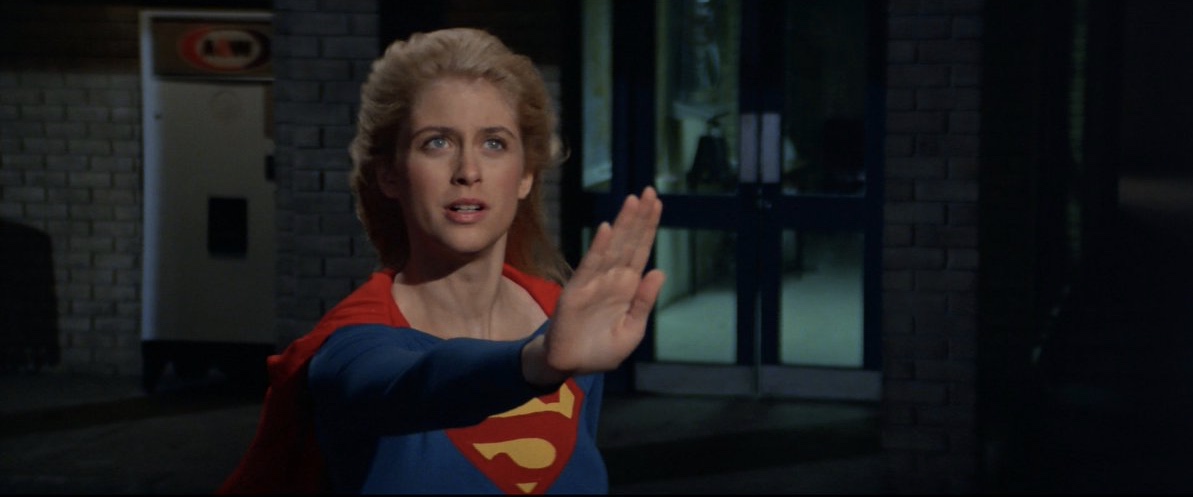
Supergirl (1984) - Comic to Movie #3

A stormdragon? A Supergirl!

Director
Jeannot Szwarc

Cast
Helen Slater - Kara Zor-El/ Linda Lee/ Supergirl
Peter O' Toole - Zaltar
Mia Farrow - Alura In-Ze
Peter Cook - Nigel
Brenda Vaccaro - Bianca
Hart Bochner - Ethan
Maureen Teefy - Lucy Lane
Marc McClure - Jimmy Olsen

I'm reviewing the 1984 movie Supergirl more for my own sake than for anyone who reads this blog and never realized this movie exists. Or, maybe they once heard about a Supergirl movie, but didn't care enough to see if it actually exists. Well, it exists. It's not necessarily obscure, but I have met many people who weren't around when this movie was released, or even in the same decade of its release, and never heard of it.
My family had a copy of Supergirl recorded off television when I was a kid. I liked it back then because it's Supergirl - a continuation of sorts to the Superman movies. But I haven't watched it since I was really young. That was about 30 years ago. So, I only recalled a few random scenes here and there.
Today, though the movie is often panned, some still hold it in somewhat of a high regard. So, I wanted to make it a part of this "comic to movie" thread I have going on, on this blog. I want to see what I think of Supergirl now that I've matured since those days of watching the TV version.
Helen Slater who plays Supergirl is still fondly remembered for this role. She appeared on Smallville as Superman's real mother, Lara. And Slater also appeared as Supergirl's adoptive mother on the current series, Supergirl.
How many female superheroes where featured in their own movie prior to 1984? Lynda Carter played Wonder Woman on TV between 1975 and 1979. She's the only other person who comes to mind.
But female superhereos weren't deemed as marketable back then for the big screen as their male counterparts were. So, despite whether Supergirl is good, bad, or in-between, it has a special place for paving the way for other female hero films like Tank Girl, Elektra, WonderWoman, and Captain Marvel to name a few titles. They only got better and better.
Helen Slater.
In the movie, Kara Zor-El (Helen Slater), the biological cousin of Kal-El (Superman), lives in a community of Kryptonians inside a place called Argo City.
One Kryptonian named Zaltar (Peter O'Toole) lets Kara witness first hand the power and ability of an object called the Omegahedron - a powerful tool that, along with another piece of technology called the alphahedron, powers the entire city.
Zaltar has the Omegahedron without the knowledge of the Argo City leaders. When he's questioned about it, he secretly kicks it over to Kara who's sitting on the floor attempting to create a large dragonfly, or some kind of big colorful insect, out of her imagination with a tool that goes with the Omegahedron.
The insect comes to life, starts flying around her, and then flies through a window causing the Omegahedron to get sucked out and shoot through space.
It travels all the way to earth and lands at a picnic site where the kind-of sorceress, Selena (Faye Dunaway), and maybe-warlock, Nigel (Peter Cook), are hanging out.
Selena claims it despite having no idea what it is or where it came from. Somehow, she happens to know how to use this alien object. Poor writing is common throughout the movie and this is one example.
As Selena is driving away, we hear on the car radio that Superman is on a "peace seeking mission" in some distant galaxy. That's Hollywood speak for Christopher Reeve probably read the script and said "nope." Reeve was slated to be in the movie but dropped out early on.
Kara arrives on earth to find the technology she lost in Argo City. Once she exits her spaceship, which landed in the bottom of a lake, Kara discovers all her powers insanely quickly. Keep in mind it took Superman years from when he landed on earth to when he developed his fortress of solitude to learn of his powers and abilities. Kara took a few minutes with a drawn out flight scene.
So, now she's Supergirl and decides to disguise herself as Linda Lee - a mild mannered student in a girls school. She also identifies herself as Clark Kent's cousin.
Linda becomes roomies with a girl named Lucy Lane, the sister of none other than Louis Lane. Whatta coincidence! And guess who teaches at this school. Nigel!
Meanwhile, Selena, who hides out inside a carnival haunted house ride, realizes the Omegahedron has the power to make her spells real.
She works towards gaining power and influence, but soon becomes enamored with a school grounds keeper named Ethan (Hart Bochner).
She makes a love potion and lures Ethan into her spooky ride lair. He unwittingly drinks it, and passes out.
When he wakes up, and Selena is distracted by a knock at the door, Ethan walks out and ultimately finds Linda whom he falls in love with thanks to the spell.
(As I write this, I'm now finding the story rather convoluted.)
Selena spies on him through some magical spell, and grows angry when he sees him fall in love with this random student. She uses her magic to bring Ethan back, but he's rescued by Supergirl.
So, this battle of good versus evil really boils down to a fight over a guy! How laughable.
Peter O'Toole and Mia Farrow in Supergirl.
After sometime, Selena traps Supergirl and sends her to the Phantom Zone where she runs into an exhiled Zaltar.
Having lost her powers in the Phantom Zone, Zaltar shows her how to escape while sacrificing himself.
Supergirl comes back to earth, and battles Selena.
There are too many inconsistencies in the cutaways. It seems there's poor execution in camera work, and no one cared enough to clean up some of the shots during the editing process.
And the poor writing makes the movie feel rushed. This is evident with Kara figuring out her powers and abilities immediately upon arriving to earth. She can figure all that out with no problem, but can't seem to grasp simple earthly idiosyncrasies and behavior. Also, how did she acquire her outfit upon arriving on earth? 
And how did Alura know about the Phantom Zone? There's too many plot holes.
Aside from the nearly all-star cast of high profile actors, the movie is very imaginative in its imagery. As Selena is a kind-of witch, using black magic and sorcery to gain power, the imagery fits but still leaves the movie coming across at times like a bad fever dream.
Jimmy Olson (Marc McClure) is the only character from Superman who returns in this movie. Otherwise, the only other cameo is Reeve's Superman on a poster hanging on Lucy's dorm wall.
Supergirl just falls flat on its face. But somehow still maintains an integral place in the genre of comic book movies.
It's the writing and story that makes the movie collapse. But the studio must have had confidence in this production. The cast in the movie speaks for itself.
I'm sure the bulk of the budget went towards casting such high profile actors like Peter O'Toole, Faye Dunaway, Mia Farrow (who plays Alura In-Ze - Superman's aunt), and Peter Cook. I wonder if that hurt the special effects budget, as well as budgets elsewhere. With such a stellar cast, you'd think producers would want a more solid movie. Someone must have thought "we really need to clean this up."
A theatrical remake has great potential to make Supergirl the movie superhero she deserves to be.


Wednesday, February 19, 2020

Don't Fast Forward This One: How The Wizard of Oz Can Settle Some Movie Debates

Escape from Reality
A few years ago, I was talking to an old high school friend - one I had a huge crush on while in school, but have remained good friends with since - who at the time had never seen any Star Wars movies.
Claiming she only enjoyed westerns, she argued that Star Wars wasn't based in reality, so watching it would be a complete waste of time.
As ridiculous a statement as that is, I was baffled by it. Movies are meant to pull audiences out of reality and into a fictional (to some degree or another) story. It's why people go to the movies. Everyone needs a pause in life. Everyone wants to just escape reality and put their worries aside, even if just for an hour or two. Movies are a great, imaginative, and intriguing way to do just that.
"Well, The Wizard of Oz certainly isn't based on reality, either. But I wouldn't dare throw that movie away," I said.
The fact that Oz strays from reality is what makes it remarkable and enjoyable. It's what gets people watching again and again 80-years later. It's an absolute masterpiece. I think of it as one of those movies that everyone has to see at least once, like E.T.: The Extra-Terrestrial. Snow White and the Seven Dwarfs, and of course Star Wars: A New Hope.
If movies were supposed to be based completely in reality, they would have died as a trend long ago.

Good Witches vs. Bad Witches
Now, I'm not much of a Harry Potter fan. I have read all but one of the books. Despite the story being imaginative, original, and clever, the writing is rather poor. But that's beside the point.
As for the movies, I've watched each one of them.
The first of the series was fun and enjoyable, but each sequel gradually grew worse than before. I can't even remember the last four or so.
Nevertheless, I appreciate and respect the fanbase behind Harry Potter. When author J.K. Rowling was pounding out those books, and Hollywood was making millions upon millions off her work, a lot of arguments surfaced, and stuck around to this day, among critics, especially the religious ones.
There's claims that the Harry Potter stories were "evil" due to the use of magic, wizards, witches, and the like within the stories.
There are good witches and wizards, and there are bad ones in Harry Potter. It's pretty easy to distinguish the good ones from the bad ones. Same with the spells they cast- bad spells, and not-so-bad spells. But their presence in the story is somehow evil altogether according to the Christian standpoint.
Well, if that's the case, then I guess The Wizard of Oz is evil, too.
In Oz, there's a (ahem) "good" witch and a wicked witch. Both of whom cast spells. And that's pretty much what's taking place in Harry Potter, but on a dominant scale.
So, if one is o.k., why isn't the other? Is it because one's old, and one's currently popular?
The good and evil is distinguishable in both stories. Neither is depicted as the opposite (i.e. good is evil, and evil is good). I'd have an issue with that if such was the case.
When it comes to the Harry Potter spells in themselves, some critics claim they're real spells actually used in black magic thus making the books and movies off limits to Christians and other religious folks.
Despite that claim being completely untrue as the words are based on ancient languages, especially Latin, to sound real and old, and stuff, people still throw it around. Those spells are completely fictitious, just like the spells used by the Wicked Witch in The Wizard of Oz. 
But some religious individuals might still claim the story glamorizes and encourages black magic. I guess imagination and creativity to tell a story can take a hike. Are fiction writers never to use witches, wizards, magicians, etc., in their stories? L. Frank Baum did.
They're simply tools used to tell a story. Nothing more.

"But it wasn't like the book!"

That classic, yet unsavory, argument is always, always brought up when a movie based on a book is released. It's nails on a chalkboard with me.
Of course, a movie should respect the source material, but the quality of a film shouldn't be judged on how closely it follows the book.
Normally, the author of whatever book a movie is based on isn't sitting in the producer nor director's chair. Maybe they'll join in the production as an adviser, like Roald Dahl did for Willy Wonka and the Chocolate Factory, or Stephen King for a ton of movies based on his books. But with movies, someone else is telling the story.
The Wizard of Oz was written by L. Frank Baum. The movie was directed by Victor Fleming, and strays quite a bit from the book. So, in reality the movie should be called The Wizard of Oz as told by Victor Fleming.
This is true for any movie adaptation. The Lord of the Rings as told by Peter Jackson. Breakfast at Tiffany's as told by Blake Edwards. Mary Poppins as told by Walt Disney.
And though such movies are never exactly like the book to some degree or another, they still work and are deemed movie classics.
The Wizard of Oz film changes the silver slippers as seen in the book to the famous ruby slippers for production's sake.
If I were to ask 50 random people what color Dorothy's shoes were in the story (not distinguishing movie or book), I'm willing to bet more people would say "red" than "silver."
Also in the movie, the Wizard appears in the same form when Dorothy and the gang all visit him at the same time rather than one at a time, on consecutive days as depicted in the book. He takes on different forms for each character.
And no one in the movie is required to wear green shades when entering the Emerald City like they were in the book.
The books are more imaginative and creative than the movie lets on. But overtime, it seems audiences are o.k. with that. I know I am.
There's a lot of changes between the book and the movie, but it doesn't matter much. The movie respects the source material, and that's the most important thing. In other words, the message of the author still manages to come through in the movie no matter how much movie writers try to make the story their own.
This is always the case in Disney animated adaptations of books. When someone says "Pinocchio," how many people think immediately of Carlo Collodi before thinking of Walt Disney? My guess is not many. Disney managed to tell a lot of stories written by various authors, and make so many his own. Pinocchio, and pretty much all those other Disney animated classics bear the label "Walt Disney's Masterpiece." Wow! Masterpiece! The definition of masterpiece is "a work of outstanding artistry, skill, and workmanship." With Pinocchio, Disney's version barely resembles Collodi's original story. Yet... "masterpiece!"
What's kind of funny is that no one ever complains when a novelization doesn't quite follow a movie.
The novelization of the 1989 movie Batman has a scene with Batman riding a horse! That part isn't in the movie. And that's just one example. Imagine if the movie had Batman on horseback. Epic! Maybe? It certainly would have changed Batman's persona a bit.
Nevertheless, The Wizard of Oz is proof a movie adaptation doesn't need to precisely follow the book it's based on. And why should it? How many book lovers are fully satisfied with a story's movie version?
Movies such as Chitty Chitty, Bang Bang and Who Framed Roger Rabbit barely resemble the books they're based on, and yet, they're fantastic and held in high regard just like The Wizard of Oz.
Even the movie The Ten Commandments strays from the Book of Exodus found in the Old Testament. Is that a bad movie?
Movies are a different medium than paper and ink. That's why movie makers often don't bother retelling the story the same way the author did it first. So, they just throw some book references towards the audience, and still wind up with fantastic, spectacular films...like The Wizard of Oz, with its good and bad witches, and the way it pulls the audiences out of reality.

Tuesday, February 4, 2020

Don't Fast Forward This One: The Movie 'Stan and Ollie' Changed My Opinion of 'Chaplin'

Robert Downy, Jr. as Charlie Chaplin in the 1992 film Chaplin.
When it comes to biographical movies, portraying the entire life of a person can be tricky. Sometimes it works. Often, there's too much content to process in one sitting and results in the audience loosing interest.
I prefer bio pictures that focus on one particular part of a person's life as opposed to a long movie attempting to cram an entire life into two-plus hours of screen time.
Again, that's not to say doing so doesn't work. It certainly worked for the 2004 movie Ray about the life of singer and songwriter, Ray Charles.
The recent movie Judy about legendary actress and singer Judy Garland worked well overall as it focuses primarily on Garland's London tour and the events of her past that effected her up to that last year of her life during that tour. It was an overall great movie, and certainly not cluttered and crammed with facts and events.
I suppose how a person's life is portrayed on screen depends on who the movie is all about.
The 2005 movie Walk the Line covers a lot of life events surrounding singer Johnny Cash and his talent as a musician. But the central focus of the movie is his love for and pursuit of June Carter. There's something consistent for viewers to grasp on to while watching this depiction of his life.
One recent bio pic Stan and Ollie (2018) depicts famous comedy duo Laurel and Hardy. The movie is a success as it portrays the team, who's real life fame peeked in the 1930s, during a European tour in the 1950s. By that time, they were still famous but were older and not quite the duo they used to be film. It's a fantastic movie, hands down!
What makes the movie work is its focus on one particular part of their lives (i.e. their last tour), and how they manage to maintain their passion for comedy as well as working together despite hardships, setbacks, anger and frustration. Still, Stan and Ollie maintain their deep rooted friendship, even amidst an argument and gradually attract new fans during their shows.
There's something in that movie for the audience to take away. We can see just from this particular depicted event from Laurel and Hardy's life what made them both beloved and an admired, talented team.
Watching Stan and Ollie made me see another bio pic I love in a new light.
As one critic put it regarding the 1992 biopic Chaplin about the life and career of comedian Charlie Chaplin, the movie covers too much ground. And it does!
The movie begins with Chaplin's poverty during his youth, to the mental breakdown of his mother, jumping to his begins as a comedian in London's Vaudeville, and then on to Hollywood, all the way up to his Oscar win in 1972. That's an entire lifetime packed into two hours and 25 minutes. For what that is, it's fine. The general premise is that Chaplin is relaying his life to a fictional biographer played by Anthony Hopkins. I get what the movie is trying to do. Still, it misses something.
Robert Downy, Jr., is the perfect casting choice to play Chaplin in the movie. He is just as memorable playing Charlie Chaplin as he is as Iron Man in the Marvel Comic movies. I can't picture anyone else in the role.
But it clicked after so many years of loving this movie that Chaplin covers way too much of the comedian's life, and doesn't touch on what made this entertainment icon so talented and memorable nearly enough.
Sure, there are depictions of how dedicated to the art of film making he was, and how much passion he had. It's there. Chaplin was a writer, producer, director, and actor. He also wrote the music to his own movies. But there's too much focus on his personal love life in the movie. I mean, it doesn't add anything to the story. What's the audience supposed to take away from such tabloid content? 
Even the tagline for the movie reads, "Everyone has a wild side. Even a legend." So, is the movie about his "wildside" or about what made Charles Spencer Chaplin into "Charlie Chaplin."
Steve Coogan and John C. Reilly as Stan Laurel and Oliver Hardy in
Stan and Ollie (2018).
Yes, Chaplin loved women! Many famous actors do. That's certainly no revelation. He was married several times, and to put it bluntly, he loved sex... a lot! But is that what made him the memorable icon he is? Is that what made his popularity withstand the test of time? Of course not.
The focus Chaplin has on his love life distracts from the real gem of Charlie's life - his remarkable talent. That's way more interesting than the tabloid stuff of who he fooled around with before settling down with his fourth wife, Oona O'Neill.
For one thing, Chaplin made two successful silent movies when talking movies had already been established as the new norm in motion pictures - City Lights and Modern Times. The latter is considered one of the greatest social commentary films ever made. This talent Chaplin had to accomplish such a feat would have been a real interesting aspect for the movie to explore deeply rather than mention it and move on.
Or, a film surrounding his expulsion from the United States during the Sen. McCarthy era, and what that meant to this actor who spent years and years working to entertain American audiences, would have been an eye-opening movie.
But what we got in 1992 was, well...as critic Peter Travers of Rolling Stone Magazine put it, "soporific."
One specific part of the movie always bothered me because it's just blatantly wrong.
Chaplin's very first on-screen appearance was in a movie called Making A Living (1914). It wasn't until his second movie Kid Auto Races at Venice (1914) that Chaplin dawned his iconic appearance with his Derby hat, bamboo cane, toothbrush mustache, and famous walk. It's the screen debut of his character, the "little tramp."
The movie shows a camera man trying to film a "baby-cart race" while a spectator (Chaplin) keeps standing in front of the camera, intrigued by the aspect of being on film. It's a showcase of his famous character which he went on to portray until his 1940 movie The Great Dictator. 
However, the 1992 movie claims Chaplin's first appearance was in some made-up silent movie showing Charlie butting in on a wedding photo and attempting to woo the bride while the rest of the party end up chasing him around the set. Really? I understand liberties are often taken in biography movies for the sake of production. But this movie couldn't get this absolutely crucial part of his life correct? Come on!
Marisa Tomei and Robert Downy, Jr.
Don't get me wrong. There's so much about Chaplin that's fantastic! It's an imperfect movie, but certainly not a bad one. I love the acting. I love how Chaplin's own daughter, Geraldine Chaplin, was cast as her own grandmother (Charlie's mother). I love how this film depicts the impact his mother's mental breakdown had on him. I love how many well known actors were also cast in this as though it was Hollywood's homage to one of its prime pioneers. I even love the soundtrack. There's a ton of effort in this movie, especially from Robert Downy, Jr. He certainly did his homework before going into this project.
But I realized after watching Stan and Ollie that Chaplin is rather misguided and lacking.
Chaplin wasn't just a persecuted millionaire who loved women maybe a little too much. There's so much more to him.
But the movie focuses too much on too many other things (i.e. Chaplin's sex life and scandals) that didn't contribute to his greatness nor his legacy. Yes, those are things that are a part of his life, and can't be ignored. But why director Richard Attenborough decided to focus so much on that, I really don't know.
Where Stan & Ollie dealt with the aspects of what made Laurel and Hardy memorable as people and as entertainers, Chaplin depicts an entertainer who was great but it slows down after that.
The elements of Chaplin's greatness are there, but not on the level they should be. Maybe Hollywood will take another look at this pioneer of motion pictures, and depict his life better in a future movie.
I could ask more questions about Chaplin, but critic Roger Ebert beat me to it.
"Why not more about the movies? And where in the finished film is the greatness of Chaplin that presumable inspire you to make it?"

Monday, February 3, 2020

Heathcliff: The Movie (1986) - Comic to Movie #2

"Heathcliff just won't be undone..."

Director
Bruno Bianchi

Cast
Mel Blanc - Heathcliff
Donna Christie - Iggy
Peter Cullen - Pop
Marilyn Lightstone - Sonja

"Heathcliff, Heathcliff, no one should terrorize their neighborhood." That's the first line of the opening theme to the 1980s animated series Heathcliff. For the movie version of this show, it would be more accurate to replace "terrorize" with "rip-off."
Back in the early 1990s, I watched this cartoon at 6 a.m. each weekday morning before being hauled off to school. It was about the only cartoon on that early during the week. My only options at that hour were this, or The Flintstones. I alternated.
I'm glad I didn't know there was a theatrical release of the children's cartoon, Heathcliff.
I wasn't a die hard fan of the series. I watched it mainly because it was something to watch while eating breakfast before school.
Had I known there was a movie, and asked my mom to take me to see it back in 1986, I would have felt cheated. I know I would have.
If anyone watched the TV series before going to see this movie back then, then chances are they already saw the movie before even buying a movie ticket.
The cartoon series originally ran from 1984 to 1988. Reruns aired after the last season.
The program is based on the comic strip about an orange cat who torments the owner of the "Elite Fish Market", Mr. Schultz, and is just a general nuisance to the residents in the town of Westfinster.
Heathcliff was created by George Gately in 1973, nearly five years before Garfield made his first appearance. So, yep! Garfield isn't the original orange cat after all. Nevertheless, I don't find Heathcliff nearly as funny as Garfield.
I believe the comic strip, Heathcliff, is still published in newspapers and can be read at GoComics.com.
The movie is composed of seven different cartoons that all originally aired on television before hitting the big screen. So, it goes without saying this doesn't feel like a motion picture at all. The opening song and credits are the same as the TV series. The end credits are, too. Everything is the same. No creative differences to give audiences a little something extra and new. Nothing for fans to look forward to. It's like a TV special that got a theatrical release.
In this movie, Heathcliff relates his past shenanigans and misadventures to his three bored nephews, who lazily look exactly like their uncle, as they're stuck in the house on a rainy day.
The first story, Cat Food for Thought, sees Heathcliff become television celebrity.
In the next story, Heathcliff's Double, well...I think the title speaks for itself.
After that, the segment The Siamese Twins centers around two Siamese cats who meander through town ruining Heathcliff's reputation.
Scene from An Officer and an Alley Cat
And then in An Officer and an Alleycat, Healthcliff attends obedience school for a chance to win a lifetime supply of free cat food.
The Catfather is a parody of The Godfather.
Heathcliff enters the ring with a famous feline boxer in the segment Boom Boom Pussini.
For a children's cartoon, the last segment, Pop on Parole, leans a little dark. It's about Heathcliff's father who's out of jail on parole. His son thinks he broke out and that the police are looking for him. He does all he can to save his dad from being arrested again, only to find out the situation is not what it should be. 
Some segments continue right after the other like a big segue.
And overall, like the nephews, I was bored from the beginning all the way to the abrupt ending. I struggled to pay attention, and forced myself to be interested to what was happening.  
The studio (DiC Enterprises at the time) really ripped audiences off making them buy a ticket to watch seven cartoons they already saw on TV.
The movie is like a long, drawn out flashback episode of any given sitcom. I hated those, and still do. Those kinds of episodes are a poor attempt by studios to save money while still filling air time. Only with Heathcliff: The Movie, audiences were required to buy a ticket.
The movie does feature the voice talent of the legendary Mel Blanc (if you don't know who he is, I'm sorry for you) as Heathcliff, and Peter Cullen (the voice of Optimus Prime in Transformers among other notable characters) as Pop.
Blanc's voice talent in the series is enough to make Heathcliff memorable.
Director Bruno Bianchi was a French cartoonist, comic artist, and a co-creator of the popular cartoon, Inspector Gadget.
He started his career at DiC Entertainment, which produced the Heathcliff cartoon series.
Bianchi was also a director for other iconic 80s titles such as Rainbow Bright, M.A.S.K., and the short-lived series Popples based on the once popular toyline.
Riff-Raff and Cleo.
Watchers of the cartoon series may remember the first half of each episode dealt with Heathcliff's various escapades.
The second half of the show centered around "The Catillac Cats" - a gang of junkyard cats (Hector, Wordsworth, Mongo, and Cleo) led by another orange cat named Riff-Raff.
These characters make a few random appearances (except for Riff-Raff and Cleo) in the movie, but it's all focused on Heathcliff. Points for consistency!
Any kind of storyline, no matter how poor, would have been a better idea than this big disappointment.
It's pathetic. It's dull. Heathcliff: The Movie is the worst attempt at a cash grab I have seen so far in my life. I can't find a big enough word to emphasize how forgettable this is. No one should rip-off their neighborhood.


About "Comic to Movie"
In this new year, I'm going to sort through over 30 obscure, forgotten, or overlooked titles based on comic books and comic strips. I'll see which ones still deserve appreciation, and which are better left in the garbage can of comic book cinema - forever disposed like those childhood comics your mom threw away when you moved out of the house.


Wednesday, January 22, 2020

Dick Tracy, Detective (1945) - Comic to Movie #1

Comic to Movie Introduction
Movies based on comic books have reached quite the zenith in the last ten or so years. I mean, they've always been a big part in what's playing at a theater in near you. And lately, new aspects in telling comic book stories on the big screen have been imagined and executed. Some have been majorly successful. Others, disastrous and forgettable. Nowadays, the concept of a "cinematic universe" is the trend to be tried in Hollywood thanks in large part to Marvel Comic's various movies based on their heroes and villains.
Some comic book based movies changed the genre and created new standards and imagery for audiences such as Tim Burton's Batman (1989). His movie made the caped crusader a darker, grittier, and split character. General audiences at the time, especially those who weren't comic book readers, were more familiar with the campy colorful television version of Batman.
Even the most recent film Dick Tracy showed audiences that a film based on a comic strip can be a colorful production and a visual explosion unlike anything seen before. 
But this genre of movie didn't just start with Superman (1978) or even with early comic book based serials like Flash Gordon or Buck Rogers in the 25th Century that played in air conditioned theaters our parents and grandparents told us about. In my search for such movies, I found some dating back to the silent era. Others, are adaptations I didn't know existed.
So, in this new year, I'm going to sort through over 30 obscure, forgotten, or overlooked titles based on comic books and comic strips. I'll see which ones still deserve appreciation, and which are better left in the garbage can of comic book cinema - forever disposed like those childhood comics your mom threw away when you moved out of the house. And I'm going to start with a comic that holds a special place in my heart.

Dick Tracy, Detective (1945)

"Who's Splitface?"

Director
William Berke

Cast
Morgan Conway - Dick Tracy
Anne Jeffreys - Tess Trueheart
Mike Mazurki - Alexis "Splitface" Banning
Lyle Latell - Pat Patton

First, Some History
Police Detective Dick Tracy is a character from the comic strip bearing his name created by Chester Gould. Dick Tracy debuted in the Detroit Mirror in 1931. He's based on real life U.S. Federal Agent, Eliot Ness - the prohibition agent who fought to ensure no one in Chicago drank booze, and brought down infamous gangster Al Capone while doing so.
What distinguishes Tracy in pop culture, aside from his yellow trench coat and matching yellow fedora, along with his two-way wrist radio watch, is the strange rogues gallery he's always up against. They're criminals with distinctly odd and loathsome features. Flattop, Itchy, Measles, Rhodent, Pruneface, Ribs...there are literally hundreds of villains in the Dick Tracy-verse spanning decades. Crime is just as ugly on the outside as it is on the inside.
As Hollywood possesses the talent to turn a popular character into a silver screen icon, they took the fictional police detective and made some movies around him. But Tracy's on-screen high point dwindled after the sixties.
The 1945 movie Dick Tracy, Detective wasn't Tracy's first on-screen performance. His film debut was in 1937 with the serial Dick Tracy which consists of 15 chapters. In that series, the detective locks horns with the infamous "Spider Gang" through 15 different cases while also searching for his brother, Gordon.
Other 15-episode serials came out between 1938 and 1941 - Dick Tracy Returns, Dick Tracy's G-Men, and Dick Tracy vs. Crime, Inc.
The 1945 movie, Dick Tracy, Detective, was the first in a four-part installment of film-noir pulp style movies. It's followed by Dick Tracy vs. Cueball (1946), Dick Tracy's Dilemma (1947) and perhaps the most famous title of the series, Dick Tracy Meets Gruesome (1947). I say "famous" because the film stars Boris Karloff (Frankenstein) as the villain.
Morgan Conway plays Tracy in the first two films. Ralph Byrd, who played Tracy in the 15-chapter serials, reprises the role in the last two films.
Dick Tracy vs. The Mole (1941)
Of course, I'll be watching all four films in the series, starting with this first.
Tracy also appeared in the TV series, Dick Tracy from 1950 to 1951 starring Byrd once again.
Incidentally, Byrd was always the actor closely associated with the yellow trench coat wearing detective, perhaps until Warren Beatty took the role in 1990.
In 1967, a pilot episode was filmed for a live action Dick Tracy show produced by William Dozier and starring Ray MacDonnell. Dozier also produced the famous TV series Batman. At the time, Batman was suffering from low ratings which was a determining factor in ultimately scrapping Dick Tracy.
Based on the pilot, which can be watched online, it looks as though the Dick Tracy series would have had a similar style to Batman. On a side note, the show would have starred a young Eve Plumb who went on to play Jan Brady on The Brady Bunch. 
The Dick Tracy Show was a short-lived animated series from 1961 to 1962, and includes the voices of Everett Sloane and Mel Blanc.
Though named for Dick Tracy, the show really centers around his detectives fighting against the rogues gallery the comic strip is known for. The only time audiences see Tracy is in the beginning of each cartoon. All Tracy does in each episode is sit behind a desk and hand out assignments.
Also, each detective in the cartoon is a racial stereotype audiences will easily find offensive - Joe Jitsu, Hemlock Holmes, Heap O' Calorie, and Manuel Tijuana Guadalajara Tampico "Go-Go" Gomez, Jr. I think their names pretty much speak for themselves.
Still, I was given the complete set of animated shows for Christmas one year. They carry a little nostalgia for me as they used to air them on a local station out in the Bay Area back in the early 90s when Tracy again surfaced into the spotlight with the movie Dick Tracy starring Warren Beatty and Madonna. I touched upon the movie's impact earlier on this blog.

Why Dick?
I picked an early Dick Tracy film to be my first movie to watch and discuss as I sit through more than 30 titles in what I'm calling "Comic to Movie" because the character holds a special place in my comic-loving heart. I saw the 1990 film upon its theatrical release. I was eight years old, and I became a fan despite not having heard of the detective before then. I looked to my dad, who was very familiar with Dick Tracy, for some history and insight to this new-found hero. Dad was born in 1938 so he was a witness when Tracy was in his heyday.
In fact, I still have my Dick Tracy action figures which were released alongside the Warren Beatty movie. Those toys are a story in and of themselves.
Those are the only toys from my childhood that I managed to save all these years. They were spared the trash can after I moved out of my mom's place, and are still in my possession. Also, with my dad having been a fan of radio serials, and owning various collections of serials on cassettes, Dick Tracy was a favorite of his. I listened to these old radio shows from an era I never lived through. In a word, they're a lot of fun. So, there's definitely a handed-down appreciation and fascination that has stuck with me all these years.

Mike Mazurki as 'Splitface' and Morgan Conway as Dick Tracy.
So, the movie

This is the quintessential film noir crime movie. And for fans of this genre, it being a Dick Tracy story makes it hit home.
Watching Dick Tracy, Detective is like reading a pulp fiction crime novel. Such books aren't meant to be read as pieces of well-written, thought provoking, brilliant literature. They're not. They're a quick escape from reality. You buy the book for a cheap price, You jump in and forget your problems for a good hour or so - however long you need - with your favorite hero in a situation you'd likely never deal with in real life, and then it's business as usual when the book is over. A movie like this is the same kind of experience.
The story doesn't waste time jumping into the action. Nor does it hold back on the seriousness of crime. Murder is murder, and that's what the audience is paying to see.
Dick Tracy, Detective has one murder victim after another.
When a young woman is found dead, it doesn't take Detective Tracy (Morgan Conway) too long to determine the suspect to be escaped convict, Splitface (Mike Mazurki.)
Our antagonist is the epitome of mafioso. He's got a long scar splitting his face from his forehead to his cheek.
Splitface, who escapes from jail, is seeking revenge on anyone who has crossed him someway or another.
As soon as the murderer realizes Tracy is closing in on him, Splitface kidnaps his girlfriend, Tess Trueheart (Anne Jeffreys.)
The film manages to produce great intrigue and drama, though the story line is a simple one, common among classic film noir crime flicks.
Conway plays a decent Tracy who's so wrapped up on fighting crime and solving the mystery at hand while struggling to pay attention to the other important things in his life - his relationship with Tess Trueheart, and just living a life outside his police work.
He plays the detective as being completely sure of himself. He knows he'll solve this crime. So, why worry. When something goes wrong in Tracy's line of thought, it makes it that much more of a serious deal. It's his job and his version of Tracy takes it straight to heart.
Otherwise, the plot is cut and dry. You know what to expect overall. Still, the intrigue is there and enough to grab audiences attention.
It's a fun film, and a trip into an era I never lived through but still enjoy. The noir style is so ingrained in American culture that it's still familiar. I look forward to the next in the series. 

Masters of the Universe (2026)

" Hang on, it's about to get weird. " Director Travis Knight Cast Nicholas Galitzine - Adam Glenn / He-Man Jared Leto - Skelet...